Mental Fatigue and Physical Performance

The BodyDashboard Guide to Cognitive Stress, Training Quality, and Mental Recovery
Can studying, work, and mental stress make your workout harder? Learn how mental fatigue can increase perceived effort, impair endurance and decision-making, and discover practical ways to manage cognitive load for better training and recovery.

Your muscles aren't the only thing you bring into a workout. A mentally exhausted brain can change how hard the exact same training session feels.
Understand Your Body. Improve Your Performance.
You slept eight hours.
Your legs aren't sore.
You ate normally.
Yet halfway through your workout...
Everything feels harder.
The weights feel heavier.
Your normal running pace feels faster.
You're struggling to concentrate.
You want to quit.
What changed?
Maybe nothing in your muscles.
Maybe your brain was tired before the workout even began.
Hours of studying, exams, meetings, problem-solving, deadlines, emotional stress, and constant concentration can create mental fatigue. Research suggests that this cognitive load can subsequently make physical exercise feel harder and, in some circumstances, impair performance.
For BodyDashboard, this introduces another important principle:
You don't train with your muscles alone. You train with your entire system.
Let's read the dashboard.
What Is Mental Fatigue?
Mental fatigue is a psychobiological state that can develop after prolonged or demanding cognitive activity.
Think:
📚 Studying for three hours
💻 Working through a difficult project
📝 Taking an exam
📱 Constant notifications
🧠 Making decisions all day
😟 Worrying about something important
By the end, you may not be physically exhausted.
But your brain feels done.
Common signs include difficulty concentrating, reduced motivation, slower reactions, more errors, impaired problem-solving, and a feeling of being mentally drained.
Mental Fatigue ≠ Muscle Fatigue
These two sensations can overlap, but they aren't identical.
Mental Fatigue
🧠 Brain feels drained
🎯 Concentration decreases
😐 Motivation falls
⚠️ Errors increase
⏱️ Reaction time may slow
🏃 Exercise feels harder than expected
Physical Fatigue
💪 Muscles feel weak
🦵 Legs feel heavy
⚡ Power decreases
🏃 Endurance declines
😣 Soreness or stiffness may occur
Mental fatigue can exist even when the muscles themselves are capable of performing.
That's what makes it so interesting.

Your Brain Can Make the Same Workout Feel Harder
This is perhaps the most important concept in the entire article.
Researchers at the University of Birmingham examined people after cognitively demanding tasks.
When mentally fatigued participants subsequently exercised, they reported greater perceived exertion. In other words, the physical exercise felt harder.
Imagine your normal run:
Normal Day
8:00/mile
Feels like:
6/10 effort
Now imagine completing several hours of intense studying immediately beforehand.
Same pace.
Same legs.
Same cardiovascular system.
But now it feels like:
8/10 effort
That difference matters.
BodyDashboard Insight
Sometimes your body hasn't become less fit.
The effort simply feels more expensive.
Mental Fatigue and Endurance
Endurance sports appear particularly vulnerable to mental fatigue.
Running, cycling, swimming, and rowing require you to tolerate discomfort for prolonged periods.
If perceived effort rises earlier than normal, you may:
Slow down
Stop sooner
Struggle to hold pace
Lose motivation
A review discussed by Runner's World found that mental fatigue negatively affected endurance and high-performance exercise across multiple studies.
That means your brain can influence how long you're willing—or able—to continue exercising even before your muscles reach their absolute limit.

Mental fatigue can increase perceived effort, making a familiar pace or workload feel unusually difficult.
What About Strength?
The relationship between mental fatigue and strength is more complicated.
Mental fatigue does not necessarily mean your muscles suddenly lose large amounts of maximal strength.
But a mentally exhausted athlete may experience problems with:
Concentration
Motivation
Technique
Repeated effort
Training quality
Decision-making
That distinction matters.
Your theoretical ability to perform one maximal repetition may remain relatively intact...
while your ability to execute an entire demanding training session effectively may deteriorate.
For BodyDashboard:
Performance is more than maximum force.
It's also your ability to repeatedly execute high-quality work.
Mental Fatigue and Decision-Making
Now imagine sports rather than the gym.
Basketball.
Soccer.
Football.
Tennis.
Hockey.
Performance isn't simply:
Run faster.
It's:
See.
Interpret.
Decide.
React.
Execute.
Mental fatigue can interfere with attention, reaction time, emotional regulation, and problem-solving.
A physically capable athlete making poor decisions is still performing poorly.

The Student-Athlete Problem
This may be particularly relevant to BodyDashboard's younger readers.
Imagine:
8:00 AM — School
↓
Classes
↓
Test
↓
Homework
↓
SAT preparation
↓
6:00 PM — Training
Your workout didn't begin at 6 PM.
Your stress load began hours earlier.
That doesn't mean studying damages fitness.
It means cognitive workload belongs on your recovery dashboard alongside physical workload.
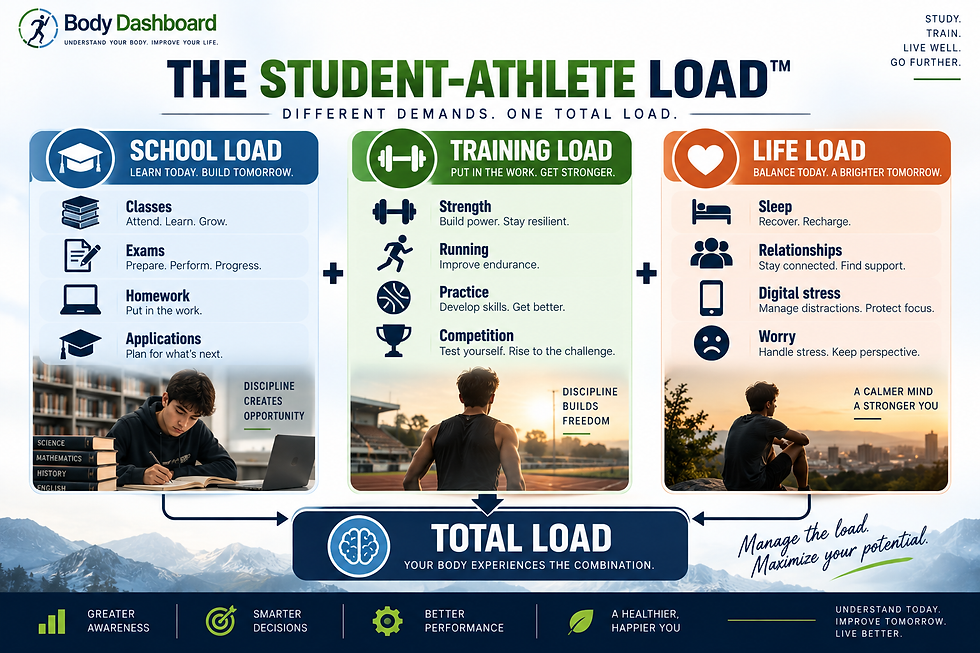
Your body experiences the combination.
Mental Stress and RPE
Athletes frequently use RPE — Rating of Perceived Exertion.
Think of it as:
1–2
Very easy
3–4
Easy
5–6
Moderate
7–8
Hard
9
Very hard
10
Maximum effort
Mental fatigue can increase RPE without necessarily changing the external workload. The Birmingham study specifically found greater perceived exertion following cognitive fatigue.
This explains something many athletes have experienced:
“I don't know why—but everything feels hard today.”
Sometimes there really is a reason.
Your Brain Has a Recovery Budget Too
Earlier, we introduced the:
BodyDashboard Recovery Bank™
Now expand it.
Physical Withdrawals
🏋 Hard training
🏃 Long workouts
🤒 Illness
Mental Withdrawals
📚 Studying
💼 Work
📝 Exams
😟 Worry
📱 Constant stimulation
Recovery Deposits
😴 Sleep
🚶 Walking
🌳 Time outside
🧘 Mental breaks
🥗 Nutrition
🛋 Rest
The important number isn't one stressor.
It's the total load.
BodyDashboard Insight
Your brain doesn't get a separate recovery account from your body.
Stress accumulates.
Should You Train After a Mentally Exhausting Day?
Sometimes yes.
A mentally difficult day does not automatically require skipping exercise.
Physical activity can improve mood and help some people transition out of work or study mode.
Instead, ask:
How important is today's workout?
Easy aerobic session?
Probably fine.
Major strength test?
Maybe reconsider timing.
Race-specific intervals?
Mental freshness may matter.
Technique-heavy session?
Concentration matters even more.
The goal isn't:
Mental fatigue = don't train.
It's:
Mental fatigue = adjust intelligently.

Strategy #1: Protect Important Workouts
If you know Tuesday contains your hardest interval session...
Don't intentionally schedule your most mentally demanding activity immediately beforehand when you have flexibility.
For students:
Hard training might fit better:
before a marathon study session
rather than:
after four hours of uninterrupted studying.
For adults:
Consider whether your hardest workout belongs before work, after a lighter workday, or on weekends.
You don't always control your schedule.
But when you do:
Use it strategically.
Strategy #2: Create a Transition
Don't move directly from:
Laptop
↓
Hard workout.
Create a buffer.
Even 10–20 minutes can establish a psychological transition.
Try:
🚶 Walk
💧 Hydrate
🍌 Eat if needed
🎧 Listen to music
🌳 Go outside
🫁 Slow your breathing
Then train.
The goal is to tell your brain:
The previous task is finished.

Strategy #3: Use Your Warm-Up as a Diagnostic
Your training plan says:
Intervals.
Your brain says:
Absolutely not.
Don't decide based entirely on how you feel sitting in the car.
Warm up first.
Then reassess.
After 10–15 minutes:
Feeling better?
Continue.
Still mentally flat?
Modify the session.
Technique deteriorating?
Stop or switch to easier training.
Your warm-up isn't only preparing your muscles.
It's gathering data.
Strategy #4: Reduce Decision Fatigue
Every decision consumes attention.
What workout?
Which exercise?
How many sets?
What should I eat?
When should I train?
What shoes?
Remove unnecessary decisions.
Prepare:
Training plan
Gym clothes
Water bottle
Workout nutrition
Training time
in advance.
The fewer decisions required immediately before training, the more attention remains for the workout itself.
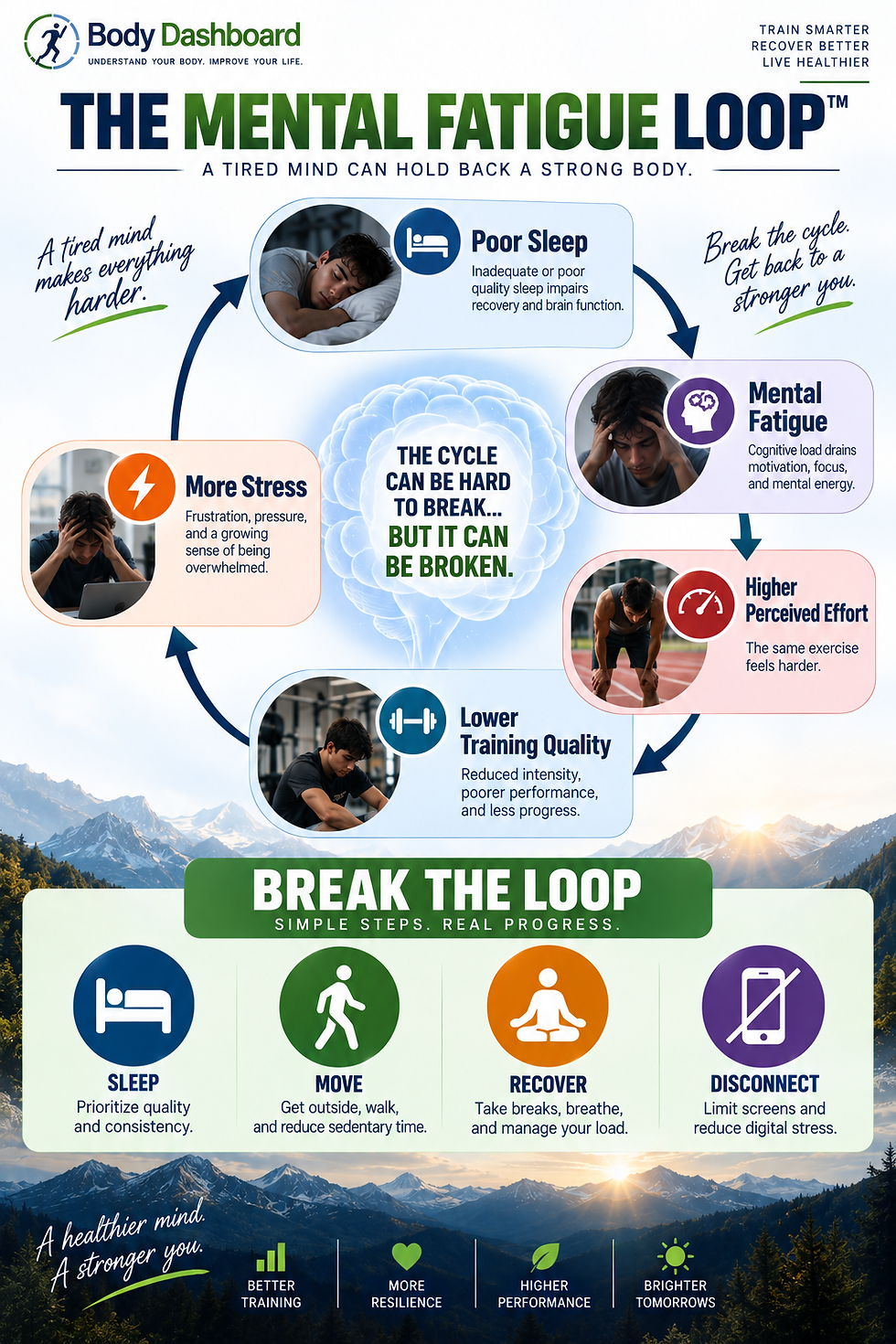
Strategy #5: Sleep
Mental fatigue and sleep are tightly connected.
Poor sleep can produce:
Reduced attention
Lower motivation
Increased perceived effort
Worse emotional regulation
And then mental stress can make sleep worse.
Creating a cycle:
Poor Sleep
↓
Mental Fatigue
↓
Harder Training
↓
More Stress
↓
Poor Sleep
Breaking that cycle often begins with sleep.
Strategy #6: Fuel Your Brain and Body
Not every bad workout is mental fatigue.
Sometimes you're simply under-fueled.
Before blaming your brain, ask:
Did I eat?
Am I hydrated?
Did I sleep?
Am I recovering from previous training?
Runner's World emphasizes that fatigue can arise from overlapping sources including inadequate nutrition, poor sleep, mental fatigue, emotional fatigue, and muscular fatigue.
Don't diagnose yourself from one symptom.
Read the entire dashboard.
Mental Fatigue vs Something More
Occasional mental fatigue after a difficult day is normal.
Persistent fatigue is different.
If you experience ongoing:
Exhaustion
Major decline in performance
Difficulty completing normal daily activities
Shortness of breath
Persistent weakness
Significant mood changes
Other unexplained symptoms
don't simply assume you're mentally tired or overtraining.
Fatigue can have medical causes as well. Runner's World notes that persistent fatigue can be associated with medical conditions and should be distinguished from ordinary tiredness or training-related fatigue.
How This Applies to You
🎓 High School
Your hardest training day may also be:
Calculus test day.
SAT-prep day.
College-essay day.
Your brain has been working too.
Recognize that.
🏫 College
Classes.
Research.
Exams.
Social life.
Training.
Sleep.
These aren't independent systems.
During finals week, maintaining training may be valuable—but expecting personal records every session may not be realistic.
💼 Adults
Your body doesn't know that your stress came from a conference room rather than a squat rack.
A mentally brutal workday can affect the workout that follows.
Build flexibility into your training.
The BodyDashboard Mental-Load Score™
Before an important workout, rate five areas:
🧠 Focus
⭐⭐⭐⭐☆
😴 Sleep
⭐⭐⭐⭐⭐
⚡ Energy
⭐⭐⭐⭐☆
🎯 Motivation
⭐⭐⭐☆☆
📚 Mental Load Today
⭐⭐☆☆☆
Then ask:
What does the pattern say?
Not:
“What does one number say?”

BodyDashboard Insight
Some days the smartest way to improve your physical performance is to recover your brain first.
Quick Recap
✅ Mental fatigue is different from muscular fatigue.
✅ Long periods of cognitive work can make exercise feel harder.
✅ Increased perceived exertion is one of the most consistent findings associated with mental fatigue.
✅ Endurance performance can suffer when the brain is mentally fatigued.
✅ Decision-making, attention, motivation, and reaction time can also deteriorate.
✅ School, work, emotional stress, and training contribute to total load.
✅ Important workouts deserve mental preparation as well as physical preparation.
✅ Sleep, fueling, breaks, scheduling, and transitions can help manage cognitive load.
Final Thoughts
We spend enormous amounts of time preparing the body for exercise.
We stretch.
Warm up.
Hydrate.
Eat.
Track HRV.
Monitor soreness.
But performance doesn't begin at the neck.
Your brain determines:
How hard effort feels.
How well you concentrate.
Whether you make the right decision.
Whether you maintain technique.
Whether you keep going.
So when an ordinary workout suddenly feels extraordinarily difficult...
Don't immediately assume you've lost fitness.
Look at your entire day.
Maybe your legs aren't the problem.
Maybe your brain needs recovery too.
At BodyDashboard, that's the bigger lesson:
Performance is a whole-system outcome.
Train the body.
Protect the brain.
Recover both.
Continue Exploring BodyDashboard
The Importance of Rest Days — Why recovery is part of training.
How Stress Impacts Your Gains — How stress and cortisol influence adaptation.
Understanding Heart Rate Variability (HRV) — How your nervous system provides clues about recovery.
What DOMS Really Means — Why soreness doesn't necessarily equal progress.
Why Daily Movement Still Matters — How movement outside formal exercise contributes to health and recovery.
Inflammation: Friend or Foe — How acute stress can support adaptation while chronic stress can become harmful.
References
University of Birmingham. Mental Fatigue Can Impair Physical Performance. The study found increased perceived exertion during exercise following cognitively demanding tasks.
Runner's World. How to Tell If Your Fatigue Is Mental or Physical—and What to Do.
Runner's World. How Fatigue Affects Endurance.
Runner's World. How to Beat Mental Fatigue When You Feel Too Drained to Run.
Runner's World. Tiredness and Fatigue Symptoms: Why You Should Know the Difference.
Outside. Mental Fatigue and Athletic Performance.
About BodyDashboard
Understand Your Body. Improve Your Performance. Extend Your Healthspan.
BodyDashboard is a science-based platform exploring how sleep, nutrition, exercise, recovery, and physiology shape everything from daily performance to long-term health.
Built for student-athletes, fitness enthusiasts, and anyone who wants to understand how the body actually works, BodyDashboard connects physiology research to practical, everyday decisions.
The goal isn't simply to train harder.
It's to understand the interconnected systems that determine whether training actually produces progress.
Performance today. Health tomorrow. Longevity for life.


Comments