Why Daily Movement Still Matters

The BodyDashboard Guide to NEAT, Metabolic Health, Recovery, and Body Composition
Learn why walking, standing, taking the stairs, household tasks, and other forms of daily movement matter—even when you exercise regularly. Discover how non-exercise activity thermogenesis, or NEAT, supports metabolic health, recovery, energy expenditure, and body composition.

Your workout may last one hour. What you do during the other waking hours can still shape your health, recovery, and body composition.
Understand Your Body. Improve Your Performance.
You completed your workout.
You lifted weights for an hour.
You hit your step goal yesterday.
Now you sit through class, work, homework, commuting, meals, and screen time for most of the remaining day.
Does the workout cancel out all that sitting?
Not completely.
Structured exercise is enormously valuable. But it is only one part of your total activity.
Your body also responds to the movement scattered throughout ordinary life:
Walking between classes
Taking the stairs
Standing while talking
Carrying groceries
Cleaning your room
Walking the dog
Cooking
Gardening
Pacing during a phone call
These activities may not feel like exercise.
But they still require energy.
They still contract muscles.
They still interrupt sedentary time.
And when repeated every day, they can add up substantially.
Welcome to one of the most overlooked parts of your BodyDashboard:
Daily movement
Let’s read the dashboard.
Exercise and Movement Are Not the Same Thing
Exercise is usually:
Planned
Structured
Repetitive
Performed to improve fitness
A run, lifting session, swim workout, or cycling class qualifies as exercise.
Daily movement is broader.
It includes nearly every physical action outside deliberate training.
Scientists often describe the energy used for this movement as:
Non-Exercise Activity Thermogenesis
Or:
NEAT
NEAT includes the energy you expend doing physical activities that are not sleeping, eating, or structured sports-like exercise. It can include standing, walking, household tasks, occupational activity, and even spontaneous movement such as fidgeting.
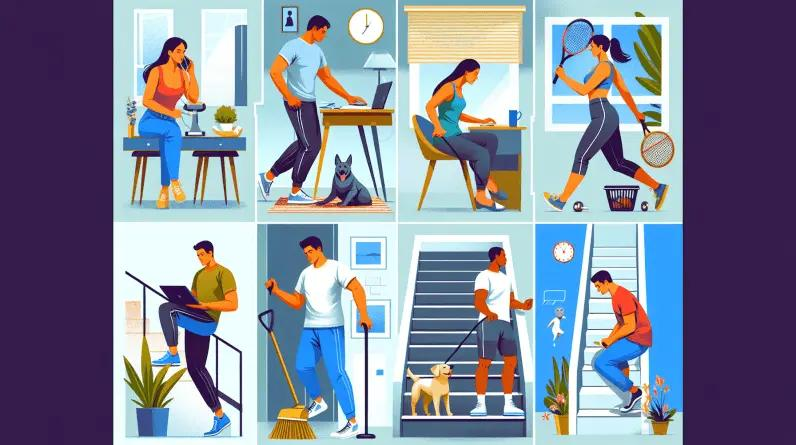
NEAT includes the small movements woven throughout daily life—not formal workouts.
The Hidden Activity Outside the Gym
Imagine two people who complete the same 60-minute workout.
Afterward:
Person A
Walks to school or work
Uses the stairs
Stands periodically
Runs errands on foot
Cooks dinner
Walks after eating
Person B
Drives everywhere
Sits through the day
Uses elevators
Orders food
Spends the evening on the couch
Both exercised.
But their total daily movement is very different.
That difference affects total activity-related energy expenditure and may influence long-term weight regulation. NEAT varies widely across people because occupations, environments, habits, and spontaneous activity differ.

Why One Workout Is Not the Whole Story
A hard workout can improve:
Cardiovascular fitness
Strength
Insulin sensitivity
Mood
Bone health
Functional capacity
But structured exercise does not make the rest of the day irrelevant.
Mayo Clinic notes that long sitting time is associated with metabolic risks and may negatively affect health and longevity even among people who achieve the minimum recommended amount of exercise. The federal Physical Activity Guidelines therefore emphasize two separate goals:
Move more and sit less.
This does not mean sitting is forbidden.
It means your body benefits when sitting is regularly interrupted by movement.
The “Active Couch Potato” Problem
You can be:
Dedicated in the gym
Fit in certain ways
Still highly sedentary throughout the day
This pattern is sometimes informally called being an active couch potato.
For example:
Workout: 60 minutes
↓
Sitting: 10–12 hours
Your workout still matters.
But it should not become permission to stop moving for the rest of the day.
A healthier approach is:
Exercise deliberately—and move naturally.
BodyDashboard Insight
Fitness is built during workouts.
Health is also shaped by what you repeatedly do between them.
Daily Movement and Metabolic Health
Your metabolism is not simply how many calories you burn.
It includes how your body:
Handles glucose
Responds to insulin
Stores and mobilizes energy
Regulates blood lipids
Maintains body weight
Muscle contractions create demand for energy.
When you stand, walk, climb stairs, or complete chores, working muscles use fuel.
Over time, a more active daily pattern can support metabolic health alongside structured exercise, nutrition, sleep, and body composition. Reviews of NEAT describe associations with energy expenditure and weight regulation, while observational research has linked higher non-exercise activity with more favorable measures such as insulin sensitivity and waist circumference.
This does not mean a few extra steps “cure” metabolic disease.
It means daily movement is one modifiable piece of a much larger system.

Daily Movement and Body Composition
Body composition describes how much of your body consists of:
Fat mass
Lean mass
Bone
Other tissues
Changing body composition still depends heavily on:
Energy balance
Nutrition
Resistance training
Sleep
Genetics
Hormonal and medical factors
NEAT contributes because it is part of total daily energy expenditure.
One walk may not change your body.
But repeatedly choosing movement over complete inactivity can create a meaningful cumulative difference over weeks, months, and years.
The key word is:
Cumulative
Five minutes of walking may seem insignificant.
Five minutes, several times a day, every day, is no longer insignificant.
Mayo Clinic specifically notes that brief activity periods can add up and offer health benefits when longer exercise blocks are difficult to schedule.
Why Dieting Can Quietly Reduce Movement
Here is something many people miss.
When people eat substantially less food, feel exhausted, or train excessively, they may unconsciously move less.
They may:
Sit more
Walk more slowly
Avoid errands
Stop fidgeting
Take elevators
Spend more time resting
Their workout may remain unchanged, but their total daily activity falls.
This is one reason body-weight change cannot always be predicted from exercise calories alone. NEAT is variable and may change in response to energy balance, environment, and individual biology.
BodyDashboard lesson:
Do not judge your total activity only by your workout.
Look at the entire day.
Daily Movement and Recovery
Hard training creates fatigue.
Recovery does not require remaining completely motionless.
When soreness is mild and no injury is present, gentle movement such as walking can be a practical way to remain active without adding another demanding training stimulus.
Daily low-intensity movement may help you:
Maintain mobility
Avoid becoming excessively stiff
Add light circulation
Support routine and mood
Stay active without creating another hard session
But movement should match your condition.
A relaxed walk is not the same as another interval workout.
And daily activity does not replace:
Sleep
Nutrition
Hydration
Rest days
Medical evaluation when pain is abnormal

Recovery movement should leave you feeling better- not create another layer of fatigue.
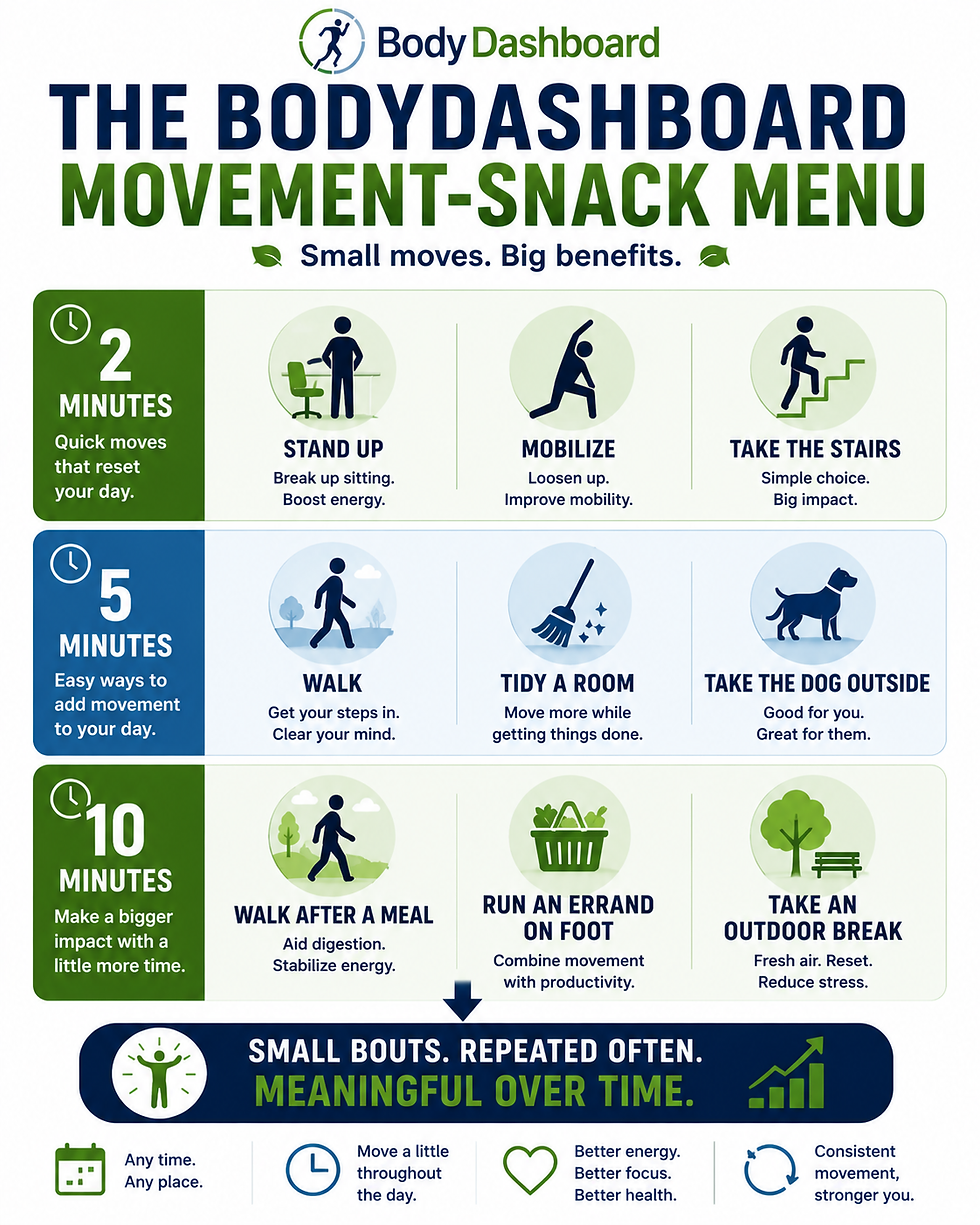
Movement Snacks: Small Bouts That Add Up
You do not need to transform every break into a workout.
A movement snack is a short burst of activity placed into the day.
Examples:
Walk for five minutes between study blocks
Take one or two flights of stairs
Stand and stretch after a meeting
Walk while making a phone call
Perform a few bodyweight squats
Carry groceries rather than using a cart for every item
Park slightly farther away
Walk after lunch or dinner
CDC guidance makes an important point:
Some activity is better than none, and activity can be divided into smaller chunks across the week.
The goal is not to make movement complicated.
The goal is to make inactivity less automatic.
The Official Activity Targets
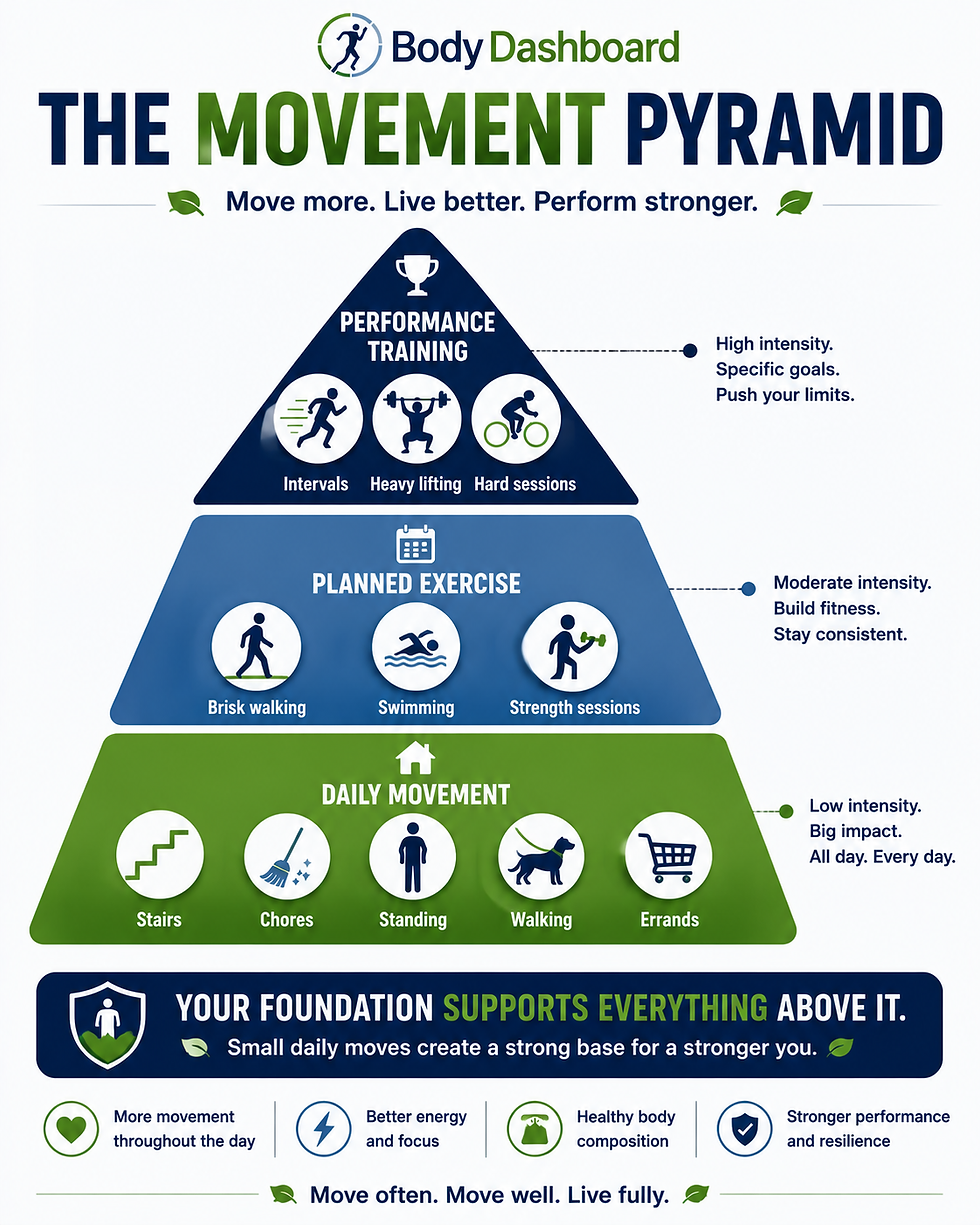
Daily movement does not replace the recommended amount of structured or moderate-to-vigorous activity.
For adults, CDC guidance recommends at least:
150 minutes of moderate-intensity aerobic activity each week, or
75 minutes of vigorous-intensity aerobic activity, or an equivalent combination
Plus muscle-strengthening activity on at least two days per week
WHO provides similar recommendations for adults and notes that additional benefits may occur as moderate activity rises toward 300 minutes per week.
For children and adolescents ages 5–17, WHO recommends an average of at least 60 minutes of moderate-to-vigorous activity daily, including muscle- and bone-strengthening activity multiple times per week.
But these targets should sit inside a larger principle:
Move throughout the day.
Do Steps Matter?
Steps are an accessible way to estimate movement.
They are useful because they are:
Easy to understand
Automatically tracked
Simple to compare over time
Helpful for identifying very inactive days
But a step count is not a complete health score.
It misses:
Cycling
Swimming
Resistance training
Carrying
Some occupational activity
Movement intensity
Exercise quality
So use steps as one dashboard light—not the entire dashboard.
The most useful question is not:
“Did I reach a perfect number?”
It is:
“Am I moving more consistently than before?”
Standing Is Helpful—but It Is Not Exercise
A standing desk can interrupt prolonged sitting.
That may help you change posture and make movement easier.
But standing still uses much less energy than walking.
The better sequence is:
Sit
↓
Stand
↓
Walk briefly
↓
Return to work
A standing desk works best when it encourages movement—not when it simply replaces sitting still with standing still.
How This Applies to You
🎓 High School
School can involve hours of sitting.
Try:
Walking during lunch
Taking stairs
Standing during study breaks
Walking between homework blocks
Joining active extracurriculars
Your sports practice matters.
So does the rest of your day.
🏫 College
College often creates extremes:
Long periods sitting in lectures or libraries
Occasional intense workouts
Irregular sleep
Meals delivered directly to the dorm
Use campus life to your advantage.
Walk to class.
Take the long route.
Carry groceries.
Explore on foot.
Daily movement can become automatic.
💼 Adults
Work and commuting can make sitting the default.
Try:
Walking meetings
Standing phone calls
Short post-meal walks
Parking farther away
Taking stairs
Setting a movement reminder
The best activity strategy is one that fits your real life.
The BodyDashboard Daily Movement Score™
Rate the following at the end of the day.
Walking
Did I intentionally walk outside exercise?
⭐⭐⭐⭐☆
Sitting Breaks
Did I interrupt long periods of sitting?
⭐⭐⭐⭐☆
Stairs and Carrying
Did I choose physical effort when practical?
⭐⭐⭐☆☆
Household or Occupational Movement
Was I physically engaged during ordinary tasks?
⭐⭐⭐⭐☆
Structured Exercise
Did I complete the planned session—or appropriately recover?
⭐⭐⭐⭐⭐
Daily Movement Score
★★★★☆
Score Interpretation
★★★★★ — Highly Active Day
You combined purposeful exercise with frequent daily movement.
★★★★☆ — Strong Day
Good activity with room for one or two more movement breaks.
★★★☆☆ — Moderate Day
Some movement, but prolonged sitting likely dominated.
★★☆☆☆ — Low-Movement Day
Add several short walks or standing breaks tomorrow.
★☆☆☆☆ — Recovery or Very Sedentary Day
A rest day may be appropriate, but gentle movement may still be possible unless illness, injury, or medical advice says otherwise.

BodyDashboard Insight
You do not need to turn every moment into exercise.
You need to stop treating movement as something that only happens at the gym.
Quick Recap
✅ Exercise and daily movement are different—but both matter.
✅ NEAT includes walking, standing, chores, errands, and spontaneous movement.
✅ Daily activity contributes to total energy expenditure.
✅ Long periods of sitting should be interrupted when practical.
✅ Short movement bouts can add up.
✅ Steps are useful, but they do not tell the whole story.
✅ Daily movement supports metabolic health and body-weight regulation.
✅ The best movement plan fits naturally into your life.
Final Thoughts
Modern life has removed movement from many ordinary tasks.
We drive instead of walk.
We take elevators instead of stairs.
We order food instead of carrying groceries.
We sit to work, study, travel, socialize, and relax.
That makes deliberate exercise essential.
But it also makes ordinary movement more valuable.
Your workout may be the highlight of your training day.
Daily movement is the background system quietly running beneath it.
At BodyDashboard, the goal is not simply to exercise harder.
It is to build a life in which movement becomes normal again.
Stand.
Walk.
Carry.
Climb.
Move often.
Because your body was not designed only for workouts.
It was designed for movement.
Continue Exploring BodyDashboard
👉 What Is VO₂ Max? Why It Matters for Your Energy, Performance, and Health
👉 Resistance Training: The Hidden Key to Strong Bones and Lifelong Health
👉 Understanding Heart Rate Variability: The Ultimate Guide
👉 What DOMS Really Means
👉 How Stress Impacts Your Gains
👉 Inflammation: Friend or Foe
👉 Nutrition: Fueling Performance, Recovery, and Longevity
References
Centers for Disease Control and Prevention. Adult Activity: An Overview.
Centers for Disease Control and Prevention. Benefits of Physical Activity.
World Health Organization. Physical Activity: Be Healthy.
World Health Organization. Physical Activity Fact Sheet.
Mayo Clinic. Exercise: How Much Do I Need Every Day?
National Health Service. Physical Activity Guidelines for Adults Aged 19 to 64.
U.S. Department of Health and Human Services. Physical Activity Guidelines for Americans.
Levine, J. A. Non-Exercise Activity Thermogenesis.
Chung, N., et al. Non-Exercise Activity Thermogenesis: A Component of Total Daily Energy Expenditure.
About BodyDashboard
Understand Your Body. Improve Your Performance. Extend Your Healthspan.
BodyDashboard is a science-based platform exploring how sleep, nutrition, exercise, recovery, and physiology shape everything from daily performance to long-term health.
Built for student-athletes, fitness enthusiasts, and anyone curious about how the body actually works, BodyDashboard connects physiology research to practical, everyday decisions—helping readers improve energy, recovery, endurance, focus, resilience, and overall performance through simple, evidence-based systems.
Performance today. Health tomorrow. Longevity for life.


Comments