The Importance of Rest Days

The BodyDashboard Guide to Recovery, Adaptation, and Long-Term Performance
Do you really need rest days? Learn how recovery supports muscle repair, nervous-system recovery, injury prevention, and better performance—and why training harder every day can eventually make you perform worse.

Rest days aren't lost training days. They're part of the process that allows training to produce results.
Understand Your Body. Improve Your Performance.
Monday: Lift.
Tuesday: Run.
Wednesday: Lift.
Thursday: Intervals.
Friday: Lift.
Saturday: Long run.
Sunday?
You feel guilty taking the day off.
Sound familiar?
Fitness culture often celebrates more:
More workouts.
More miles.
More weight.
More intensity.
But your body doesn't become stronger simply because you keep applying stress.
It becomes stronger when it has enough time to adapt to that stress.
UCLA Health describes rest days as an important part of exercise programming because recovery gives the body time to repair, build strength, and reduce injury risk. Training excessively without sufficient recovery can instead contribute to fatigue, declining performance, poor sleep, overuse injuries, and other signs of overtraining.
At BodyDashboard, that leads to one of our most important principles:
Training provides the stimulus. Recovery produces the adaptation.
Let's read the dashboard.
What Is a Rest Day?
A rest day doesn't necessarily mean lying on the couch for 24 hours.
It means taking a break from your normal training stress.
That could mean:
Complete Rest
No structured training.
Just normal daily activity.
Or:
Active Recovery
Low-intensity movement such as:
Walking
Gentle swimming
Mobility
Easy yoga
Light stretching
UCLA recommends keeping active recovery genuinely easy—the goal is to increase gentle movement without further taxing the body.
The important distinction is intensity.
Your recovery session shouldn't quietly become another workout.
Why Your Muscles Need Rest
Resistance training intentionally stresses muscle tissue.
That isn't a mistake.
It's the stimulus.
Following training, the body begins repairing and remodeling the affected tissue.
With adequate recovery and nutrition, this contributes to adaptation.
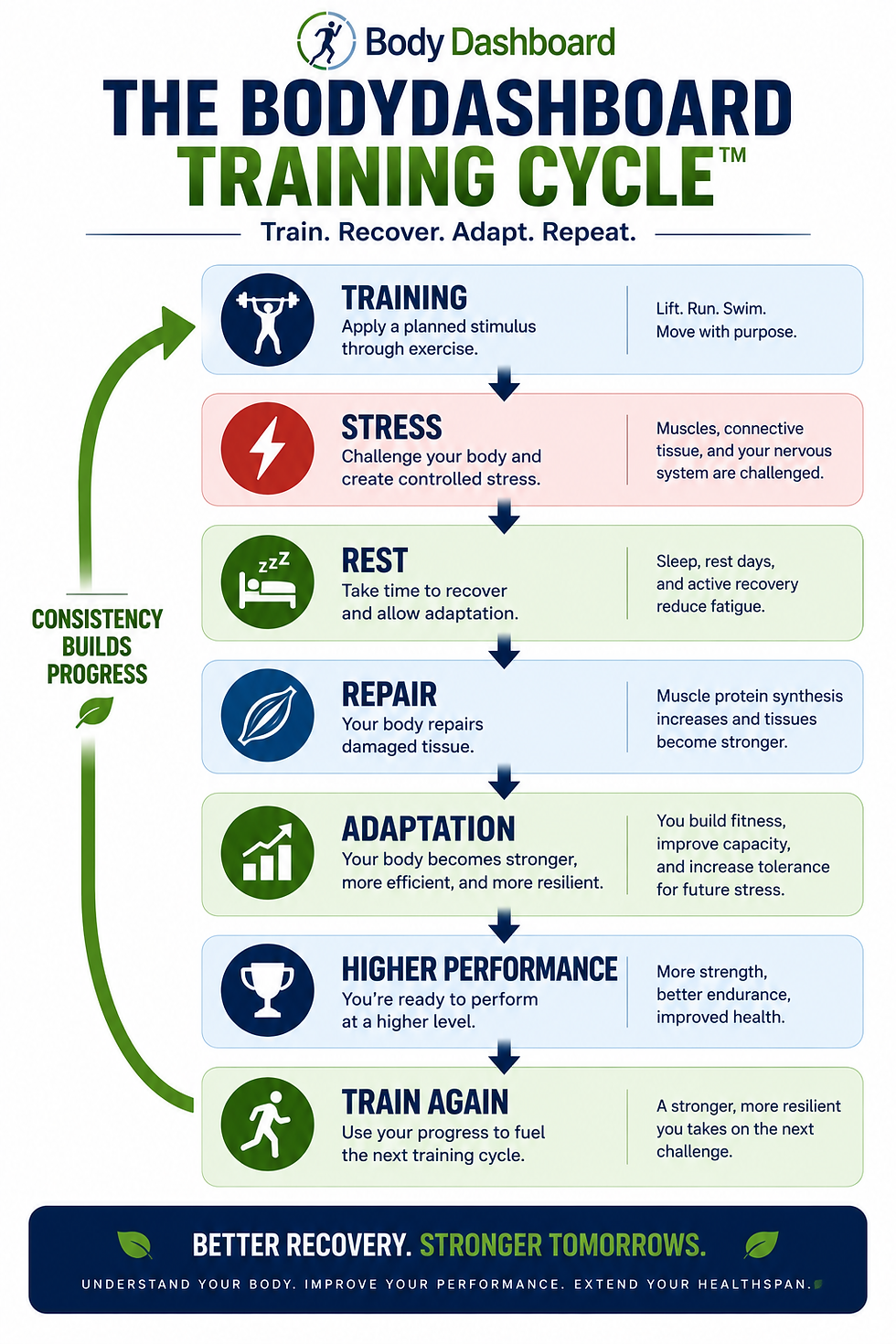
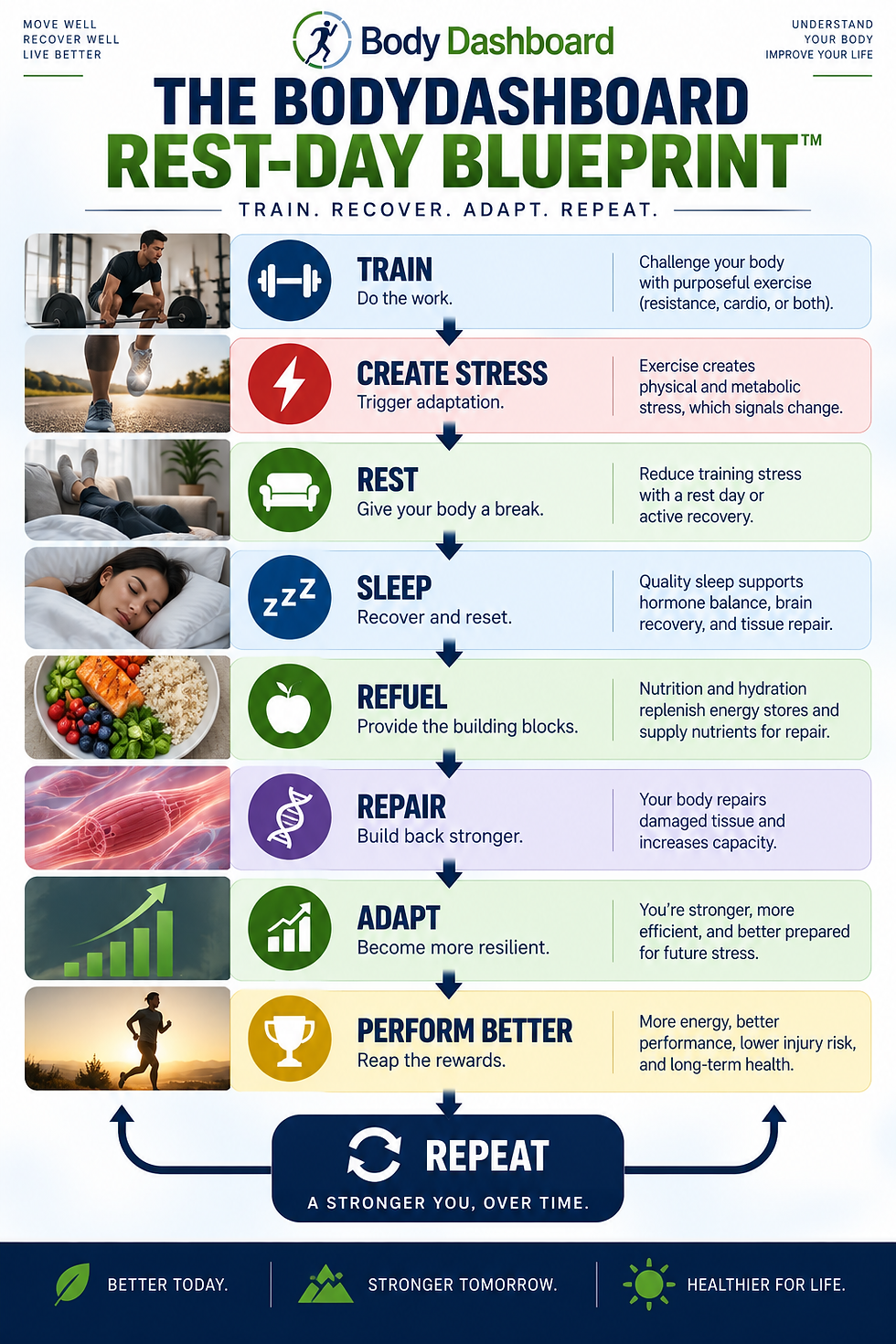
The simplified sequence looks like this:
Resistance Training
↓
Muscle Stress
↓
Repair
↓
Adaptation
↓
Greater Capacity
Rest is therefore not something that happens instead of building muscle.
It is part of the process by which training produces stronger muscle.
UCLA recommends nonconsecutive resistance-training days in some populations precisely because muscles need recovery between sessions.

Training creates the challenge. Recovery gives your body the opportunity to respond to it.
Your Nervous System Needs Recovery Too
Muscles aren't the only system being trained.
Every hard workout also challenges your nervous system.
Think about a heavy squat.
Your brain must recruit motor units.
Your muscles must coordinate.
Your sympathetic nervous system increases activity.
Heart rate rises.
Stress hormones respond.
Your body shifts into performance mode.
That's useful.
But you cannot remain in performance mode indefinitely.
Eventually the system needs to shift toward:
🌿 Rest
🌿 Repair
🌿 Sleep
🌿 Recovery
🌿 Parasympathetic activity
That transition helps prepare you for the next challenge.
Rest Days and HRV
This is where your previous BodyDashboard HRV guide becomes useful.
After difficult training, HRV may temporarily fall as physiological stress rises.
As recovery occurs, HRV often moves back toward an individual's baseline.
That doesn't mean:
Low HRV = automatic rest day.
Instead, combine HRV with:
Sleep
Soreness
Energy
Mood
Resting heart rate
Recent training load
Motivation
One number doesn't run your BodyDashboard.
Patterns do.
BodyDashboard Insight
Your muscles may feel ready before your entire system is ready.
Recovery is a whole-body process.
More Training Is Not Always Better
This is one of the hardest lessons for motivated athletes.
At first:
More training often produces more progress.
But only to a point.
Eventually, additional training without sufficient recovery produces diminishing returns.
And if the imbalance becomes large enough:
Performance can actually decline.
UCLA describes overtraining as excessive physical stress without adequate recovery. Potential consequences include reduced strength and endurance, hormonal disturbances, poorer sleep, mood changes, immune effects, and longer recovery.
So the relationship isn't:
More training = more results.
It's closer to:
Appropriate training + sufficient recovery = adaptation.

Functional Overreaching vs Overtraining
Not every period of fatigue is bad.
Athletes sometimes deliberately train hard enough that performance temporarily decreases.
With appropriate recovery, the body rebounds.
That is very different from repeatedly ignoring fatigue and continuing to add training stress.
Think of it this way:
Productive Stress
Train hard
↓
Become tired
↓
Recover
↓
Come back stronger
Unproductive Stress
Train hard
↓
Become tired
↓
Train harder
↓
Sleep poorly
↓
Performance declines
↓
Train harder again
That second cycle is where problems begin.
The Recovery Bank Account
Imagine that your body has a recovery account.
Every stressor makes a withdrawal:
🏋 Heavy lifting
🏃 Hard running
📚 Exams
💼 Work
✈ Travel
😴 Poor sleep
🤒 Illness
Recovery makes deposits:
😴 Sleep
🥗 Nutrition
💧 Hydration
🚶 Gentle movement
🧘 Stress management
🛋 Rest
If withdrawals exceed deposits occasionally?
Probably manageable.
If they exceed deposits every day?
Eventually your balance reaches zero.

Signs You May Need a Rest Day
Your body usually gives clues.
Pay attention to combinations of:
Persistent soreness
Normal DOMS should improve.
Soreness that keeps accumulating deserves attention.
Declining performance
Weights suddenly feel unusually heavy.
Your normal running pace feels difficult.
Fatigue
You feel tired before the workout even starts.
Poor sleep
You train harder—but somehow sleep worse.
Mood changes
Irritability.
Low motivation.
You no longer want to train.
Repeated injuries
Small aches become persistent.
Frequent illness
You seem to catch everything.
These overlap with warning signs UCLA lists for excessive training, including fatigue, persistent soreness, performance plateaus, sleep problems, illness, mood changes, and overuse injuries.
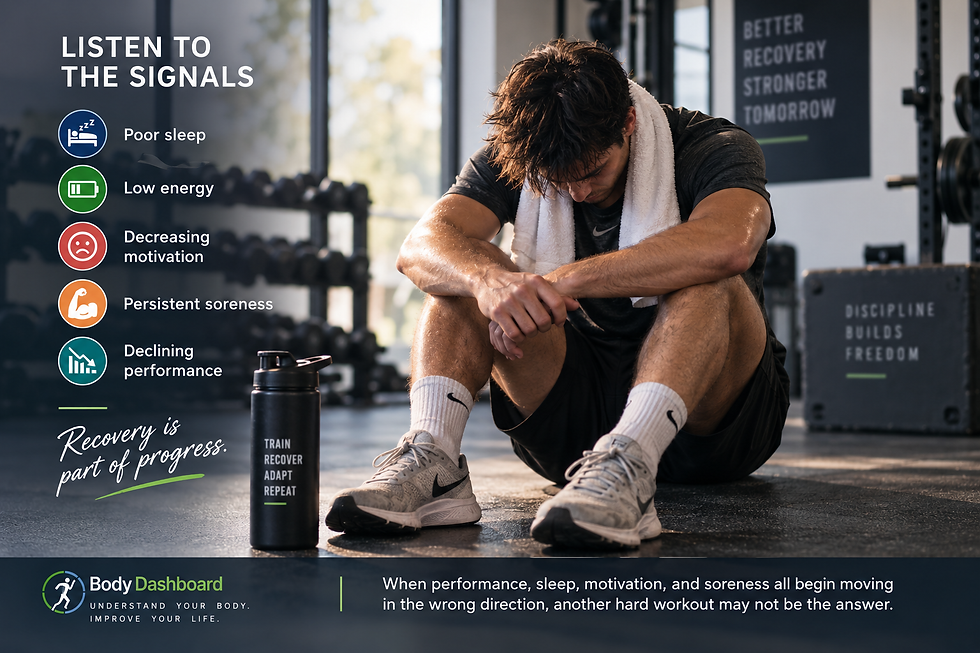
When performance, sleep, motivation, and soreness all begin moving in the wrong direction, another hard workout may not be the answer.
How Often Should You Take a Rest Day?
There is no universal schedule.
Recovery needs depend on:
Age
Training experience
Exercise intensity
Training volume
Sport
Sleep
Nutrition
Life stress
Injury history
UCLA suggests at least one day away from the usual workout routine each week as a general approach and notes that rest after especially long or intense training can be particularly useful.
But the important concept is individualization.
A beginner might need more frequent recovery.
An experienced athlete using a carefully designed split may train on more days while rotating muscle groups and intensity.
Rest days should match your training—not someone else's Instagram schedule.
The 48-Hour Idea
You've probably heard:
“Wait 48 hours before training the same muscle.”
That's a useful starting concept, not an absolute law.
Recovery varies depending on the workout.
Live Science summarizes research in resistance-trained men in which 48 hours between certain sessions was sufficient to restore performance, while shorter recovery intervals reduced performance on several lifts.
A brutal leg session may require more recovery.
A light technique session may require less.
Again:
Read the dashboard.
Complete Rest vs Active Recovery
Which is better?
It depends.
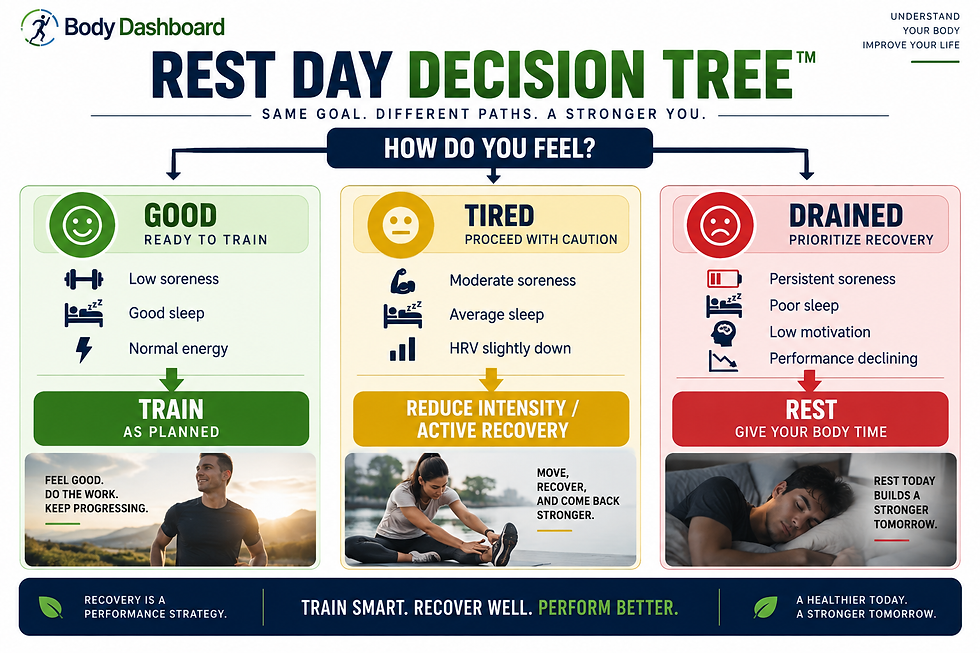
Choose Complete Rest When:
You're sick
You're extremely fatigued
Sleep has been poor
Soreness is severe
You have an injury
Your body clearly needs a break
Choose Active Recovery When:
You're mildly sore
Energy is reasonable
You want gentle movement
You're recovering from a difficult session
Examples:
🚶 Walking
🏊 Easy swimming
🧘 Gentle yoga
🚴 Easy cycling
UCLA and Live Science both describe light activities such as walking, swimming, stretching, or yoga as potential active-recovery options.
Rest Days Don't Mean Stop Moving
This connects directly with our Daily Movement pillar.
You can take a rest day from training while still:
Walking
Cooking
Shopping
Taking stairs
Playing with your dog
Moving around campus
Resting from intense exercise does not require becoming sedentary.
That distinction matters.
You are reducing training stress, not eliminating normal human movement.
Rest Days and Injury Prevention
Many athletic injuries are not dramatic accidents.
They accumulate.
One run.
Then another.
Then another.
Tendons, bones, joints, and muscles repeatedly absorb stress without enough recovery.
Eventually:
Something hurts.
UCLA notes that excessive running without adequate recovery can contribute to injury and burnout and specifically recommends incorporating rest days into marathon training.
Rest therefore isn't merely about feeling less tired.
It's also part of managing repetitive load.
Rest Days and Long-Term Performance
Think about your goal.
Is it:
Have the hardest workout possible today?
Or:
Still be training successfully ten years from now?
Those are different goals.
The athletes who last aren't necessarily the people who can tolerate the most punishment.
They're often the people who become best at balancing:
Stress
and
Recovery
Consistency requires sustainability.
The Peter Attia Perspective
The longevity framework popularized in Outlive places enormous value on maintaining fitness across decades.
That changes the goal.
You don't need one heroic workout.
You need thousands of productive workouts across a lifetime.
Rest becomes strategically important because the real objective isn't maximizing today's fatigue.
It's preserving your ability to train again.
The Gabrielle Lyon Perspective
The muscle-centric framework in Forever Strong similarly makes resistance training important across the lifespan.
But muscle requires both:
Stimulus
and
Recovery
Protein provides building materials.
Resistance training provides the signal.
Rest gives remodeling time to occur.
The goal isn't simply doing more.
It's repeatedly creating an environment in which muscle can adapt.
How This Applies to You
🎓 High School
School stress counts.
Practice stress counts.
Poor sleep counts.
If you're playing a sport while studying late every night, your recovery needs may be higher than your training schedule suggests.
🏫 College
Training isn't occurring in isolation.
Exams.
Travel.
Late nights.
Social life.
Work.
All contribute to total stress.
Sometimes skipping one hard session protects the next five.
💼 Adults
Work and family stress don't disappear when you enter the gym.
Your training program needs to fit the life you're actually living.
Not the theoretical life where you sleep nine hours every night and have no responsibilities.
The BodyDashboard Rest-Day Score™
Every morning, assess five signals.
😴 Sleep
How well did you sleep?
❤️ HRV
Near your normal range?
💪 Soreness
Improving or worsening?
⚡ Energy
Ready to perform?
🧠 Motivation
Excited to train—or forcing yourself?
Then look at the pattern.
🟢 5/5
Train as planned
🟢 4/5
Normal training
🟡 3/5
Consider reducing intensity
🟠 2/5
Active recovery
🔴 0–1/5
Rest and reassess
This is a simple educational framework—not a medical diagnostic tool.
BodyDashboard Insight
A rest day isn't a break from your program.
It's part of your program.
Quick Recap
✅ Rest supports tissue repair.
✅ Your nervous system also needs recovery.
✅ More training is not always better.
✅ Performance can decline when training consistently exceeds recovery.
✅ Active recovery and complete rest serve different purposes.
✅ Sleep, soreness, HRV, energy, and motivation can help you assess readiness.
✅ Rest days can reduce repetitive training stress and support injury prevention.
✅ Long-term consistency matters more than winning today's workout.
Final Thoughts
Fitness isn't built by seeing how much punishment your body can tolerate.
It's built by applying the right stress...
and then allowing your body to respond.
Train.
Recover.
Adapt.
Repeat.
Do that for a week and you have a training plan.
Do it for years and you build fitness.
Do it for decades and you build something even more valuable:
A body capable of performing for life.
Continue Exploring BodyDashboard
What DOMS Really Means — Understand why soreness occurs and why soreness doesn't equal progress.
Understanding Heart Rate Variability (HRV) — Learn how your nervous system provides clues about recovery.
How Stress Impacts Your Gains — Explore cortisol, stress, and adaptation.
Inflammation: Friend or Foe — Understand why temporary inflammation supports adaptation while chronic inflammation can become harmful.
Why Daily Movement Still Matters — Learn why rest from training doesn't mean eliminating everyday movement.
Resistance Training: The Hidden Key to Strong Bones and Lifelong Health — Explore the long-term benefits of resistance exercise.
References
UCLA Health — No Pain, No Gain? Training Too Hard Can Have Serious Health Consequences
The Conversation. Rest Days Are Important for Fitness—Here's Why, According to Science.
CNN. Recovery Days and Training. May 23, 2025.
Peter Attia. Outlive: The Science and Art of Longevity.
Gabrielle Lyon. Forever Strong.
About BodyDashboard
Understand Your Body. Improve Your Performance. Extend Your Healthspan.
BodyDashboard is a science-based platform exploring how sleep, nutrition, exercise, recovery, and physiology shape everything from daily performance to long-term health.
Built for student-athletes, fitness enthusiasts, and anyone who wants to understand how the body actually works, BodyDashboard connects physiology research to practical everyday decisions.
Our goal isn't to chase hacks.
It's to understand the systems that determine how we perform today, recover tomorrow, and stay capable for life.
Performance today. Health tomorrow. Longevity for life.


Comments