How Stress Impacts Your Gains

The BodyDashboard Guide to Cortisol, Recovery, Performance, and Muscle Growth
Stress affects far more than your mood. Learn how cortisol influences muscle growth, fat storage, athletic performance, recovery, and long-term health—and discover science-backed strategies to manage stress and maximize your gains.

Stress isn't always the enemy. The key is knowing when stress helps you grow—and when it begins holding you back.
Understand Your Body. Improve Your Performance.
You crushed your workout.
You hit your protein goal.
You slept reasonably well.
Yet...
You're not getting stronger.
You're constantly sore.
Your energy is low.
Your motivation is fading.
What happened?
The answer may not be your workout.
It may be your stress.
At BodyDashboard, we often think of training as the stress that builds us stronger.
But exercise is only one form of stress.
Your body also responds to:
Exams
Deadlines
Financial worries
Relationship challenges
Poor sleep
Illness
Surprisingly, your body doesn't distinguish between many of these stressors.
To your physiology...
Stress is stress.
Let's read the dashboard.
Stress Isn't the Enemy
Stress has a bad reputation.
But without stress...
There is:
no muscle growth
no endurance improvements
no adaptation
Every workout intentionally places your body under stress.
Your nervous system responds.
Your muscles are challenged.
Your body begins adapting.
The problem isn't stress.
The problem is too much stress without enough recovery.
Meet Cortisol: Your Stress Hormone

Cortisol is produced by your adrenal glands.
It is often called:
The Stress Hormone
But that title is misleading.
Cortisol isn't bad.
In fact, cortisol helps you:
Wake up in the morning
Maintain blood pressure
Regulate blood sugar
Reduce dangerous inflammation
Mobilize energy during exercise
Without cortisol...
You couldn't survive.
The goal isn't eliminating cortisol.
The goal is regulating it.
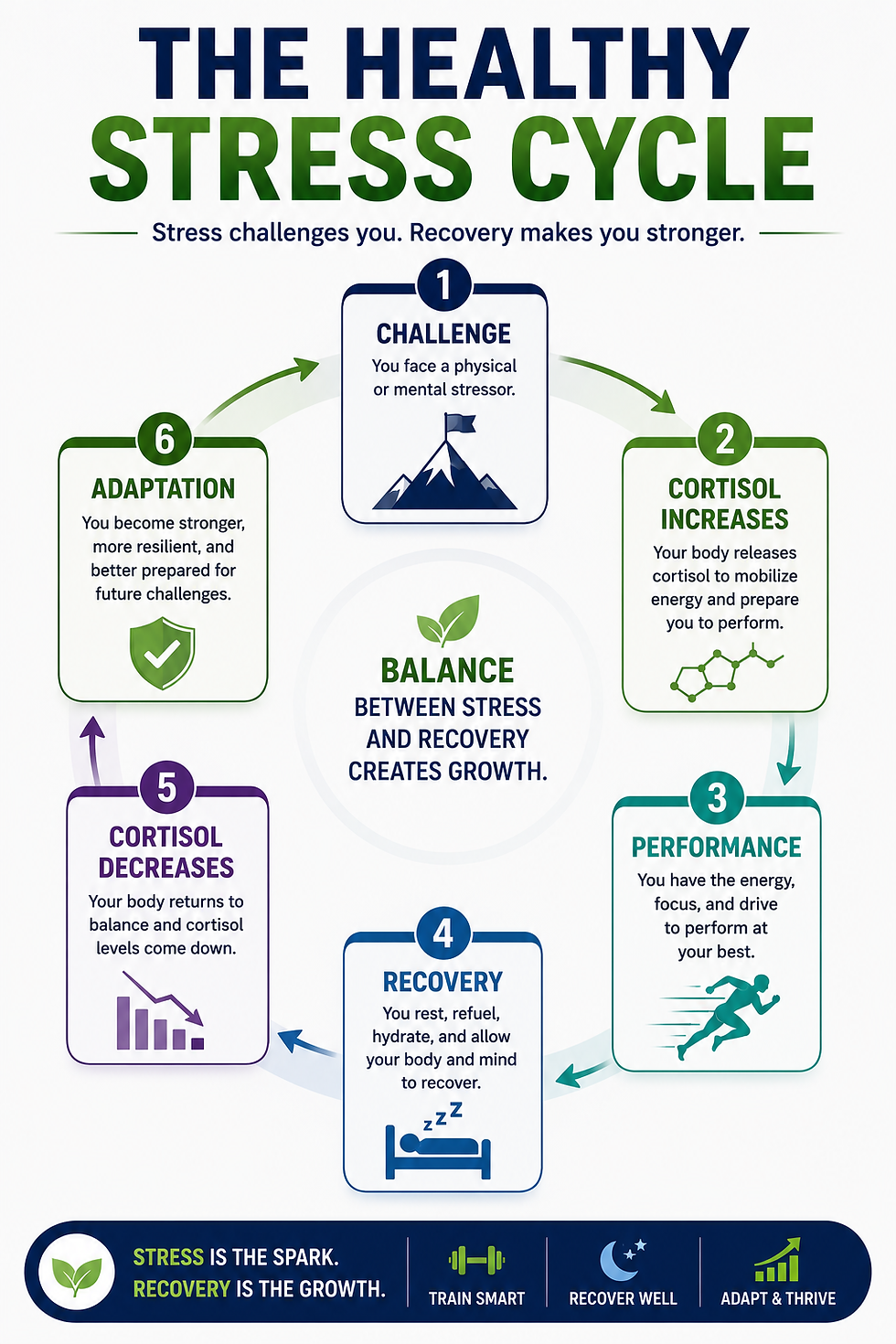
The Healthy Stress Response
Imagine you're about to sprint.
Your brain immediately tells your body:
"Prepare for action."
Within seconds:
Heart rate rises
Blood pressure increases
Blood sugar becomes available
Cortisol rises
Adrenaline increases
Your body is now ready to perform.
Once the stress ends...
Cortisol should fall.
Recovery begins.
This is exactly how the system was designed to work.
When Stress Never Ends
The problem today is that many stressors never truly stop.
Emails.
Exams.
Traffic.
Financial concerns.
Social media.
Poor sleep.
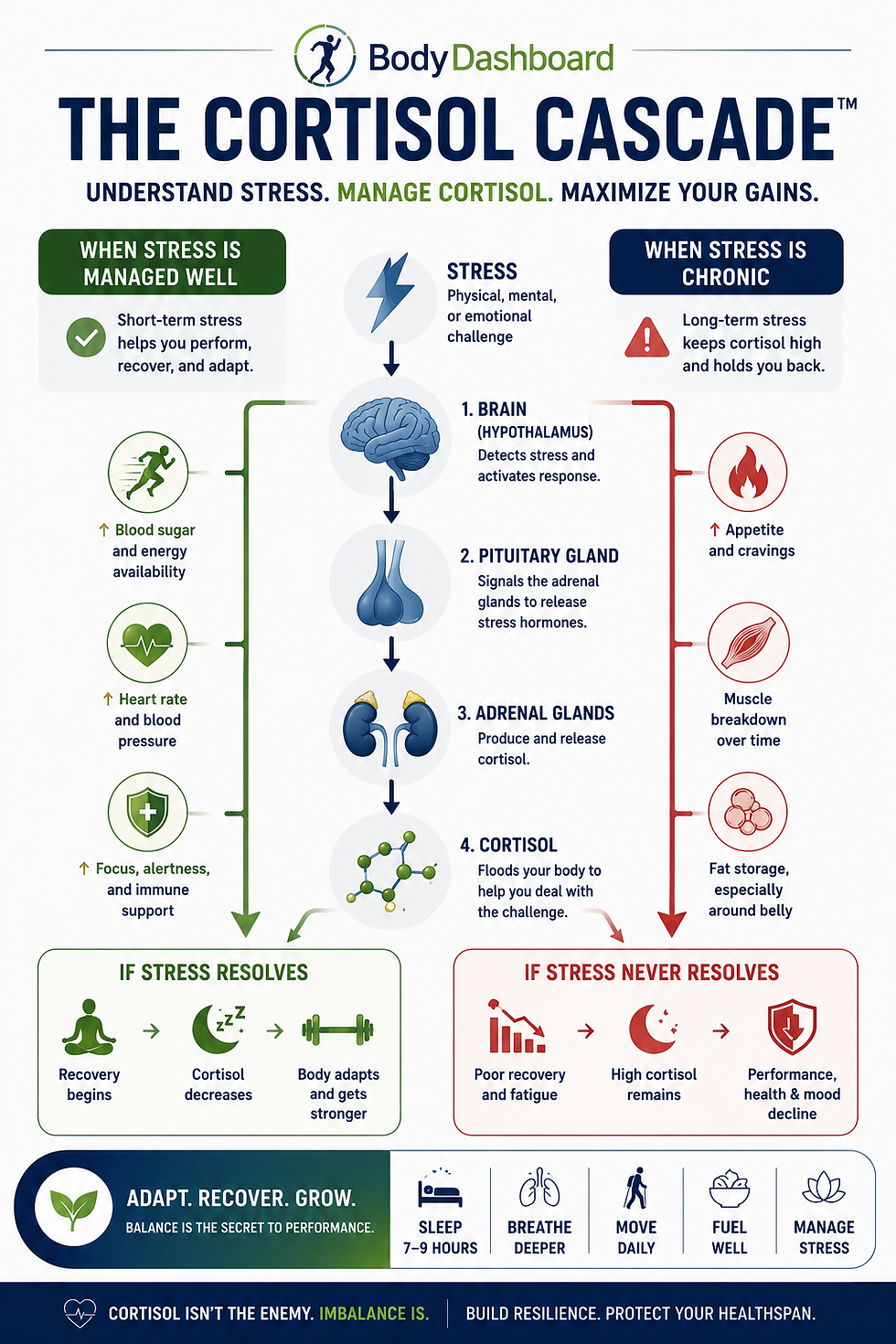
The body often remains in a prolonged stress response.
Instead of:
Stress
↓
Recovery
↓
Balance
We experience:
Stress
↓
More stress
↓
Even more stress
↓
Chronically elevated cortisol
Chronic Cortisol and Muscle Growth
One of cortisol's jobs is to provide energy.
When energy demands become prolonged...
Your body begins breaking down stored fuels.
Unfortunately...
That can include muscle tissue.
Chronically elevated cortisol may:
Slow muscle growth
Delay recovery
Increase muscle breakdown
Reduce strength gains
This doesn't mean cortisol destroys muscle overnight.
It means recovery becomes increasingly difficult.

Stress and Fat Storage
Another fascinating effect of cortisol involves body fat.
When cortisol remains elevated for long periods:
Appetite often increases
Cravings rise
Blood sugar regulation changes
Many people notice increased fat storage—particularly around the abdomen.
Combined with poor sleep and inactivity...
This creates a cycle that becomes increasingly difficult to break.

Stress Reduces Performance
Athletic performance depends on more than muscle.
Stress also affects:
Reaction time
Focus
Decision making
Coordination
Motivation
This is why elite athletes spend so much time training their minds—not just their bodies.
Stanford researchers studying professional athletes have shown that breathing techniques, mental rehearsal, and emotional regulation improve performance under pressure.
The goal isn't avoiding pressure.
It's learning how to perform despite it.
HRV: Your Stress Dashboard
Heart Rate Variability (HRV) provides one of the clearest windows into stress.
Healthy recovery usually follows this pattern:
Workout
↓
Temporary Stress
↓
Recovery
↓
Higher HRV
↓
Adaptation
When HRV remains low for several days...
Your nervous system may be telling you:
"I need recovery."
The Peter Attia Perspective
Peter Attia often reminds us that exercise is one of the healthiest forms of stress available.
The body improves because it adapts to manageable stress.
But adaptation only occurs when recovery follows.
The same principle applies throughout life.
Small, manageable stressors build resilience.
Chronic, unrelenting stress eventually becomes harmful.
The Gabrielle Lyon Perspective
Gabrielle Lyon frequently emphasizes that muscle is one of the body's greatest defenses against aging.
But muscle doesn't grow during stress.
Muscle grows after stress.
That recovery requires:
Protein
Sleep
Nutrition
Stress management
Training without recovery limits adaptation.
How This Applies to You
🎓 High School
Sports.
Homework.
College applications.
Social media.
Many students are carrying more stress than they realize.
Recovery matters.
🏫 College
Classes.
Jobs.
Relationships.
Training.
Late nights.
Your body sees all of it as cumulative stress.
💼 Adults
Career.
Family.
Financial responsibilities.
Exercise becomes even more important—but so does recovery.Managing Stress for Better Gains
Fortunately...
Stress management doesn't require perfection.
Small habits create large results.
😴 Sleep
The single most powerful recovery tool.
🫁 Deep Breathing
Even five minutes can shift your nervous system toward recovery.
🚶 Walking
Especially outdoors.
Walking lowers cortisol while improving mood.
🧘 Meditation
Improves emotional regulation and resilience.
🥗 Nutrition
Fuel your body consistently.
Avoid skipping meals during stressful periods.
💪 Exercise
Ironically...
Exercise is one of the best treatments for stress—when recovery matches training.

BodyDashboard Insight
Your body doesn't grow because you train harder.
It grows because you recover better.
Quick Recap
✅ Stress isn't the enemy.
✅ Cortisol is essential for performance.
✅ Chronic cortisol slows recovery.
✅ Stress affects muscle growth and fat storage.
✅ HRV helps monitor stress.
✅ Recovery is the key to adaptation.
Final Thoughts
Every workout asks your body a question:
"Can you adapt?"
Stress provides the stimulus.
Recovery provides the answer.
At BodyDashboard, we don't try to eliminate stress.
We build resilient systems that can handle it.
Because the strongest athletes aren't those who experience the least stress.
They're the ones who recover from it the best.
Continue Exploring BodyDashboard
👉 What Is VO₂ Max? Why It Matters for Your Energy, Performance, and Health
👉 Understanding Heart Rate Variability (HRV): The Ultimate Guide
👉 Why Sleep Is the Ultimate Performance Enhancer
👉 Nutrition: Fueling Performance, Recovery, and Longevity
👉 Inflammation: Friend or Foe
👉 Resistance Training: The Hidden Key to Strong Bones and Lifelong Health
References
Performance Orthopaedics & Sports Medicine. The Effects of Stress on Athletic Performance.
Stanford University. Deep Breath, See the Ball, Trust: How Professional Athletes Handle Stress.
Cleveland Clinic. Cortisol.
Mayo Clinic. Stress Management.
Harvard Health Publishing. Understanding the Stress Response.
Peter Attia. Outlive.
Gabrielle Lyon. Forever Strong.
About BodyDashboard
Understand Your Body. Improve Your Performance. Extend Your Healthspan.
BodyDashboard is a science-based platform exploring how sleep, nutrition, exercise, recovery, and physiology shape everything from daily performance to long-term health.
Built for student-athletes, fitness enthusiasts, and anyone curious about how the body actually works, BodyDashboard connects physiology research to practical, everyday decisions—helping readers improve energy, recovery, endurance, focus, resilience, and overall performance through simple, evidence-based systems.
Performance today. Health tomorrow. Longevity for life.


Comments