Inflammation: Friend or Foe?

The BodyDashboard Guide to Recovery, Performance, and Long-Term Health
Part 2A – Exercise, Recovery, Sleep, HRV, and Overtraining
Discover how exercise, sleep, Heart Rate Variability (HRV), and recovery influence inflammation. Learn why inflammation is essential for adaptation but harmful when recovery is inadequate.

Exercise creates controlled inflammation. Recovery determines whether that inflammation makes you stronger—or keeps you stuck.
Every Workout Creates Inflammation
Many people assume inflammation means something has gone wrong.
Ironically...
If you're training correctly, every workout creates inflammation.
That's exactly what your body needs.
When you:
Lift weights
Run intervals
Play basketball
Swim
Cycle
your muscles experience tiny microscopic damage.
This controlled stress activates your immune system.
Inflammatory cells quickly arrive to:
Remove damaged tissue
Begin repair
Stimulate new muscle growth
Prepare the body for future stress
Without this temporary inflammatory response...
There would be no adaptation.
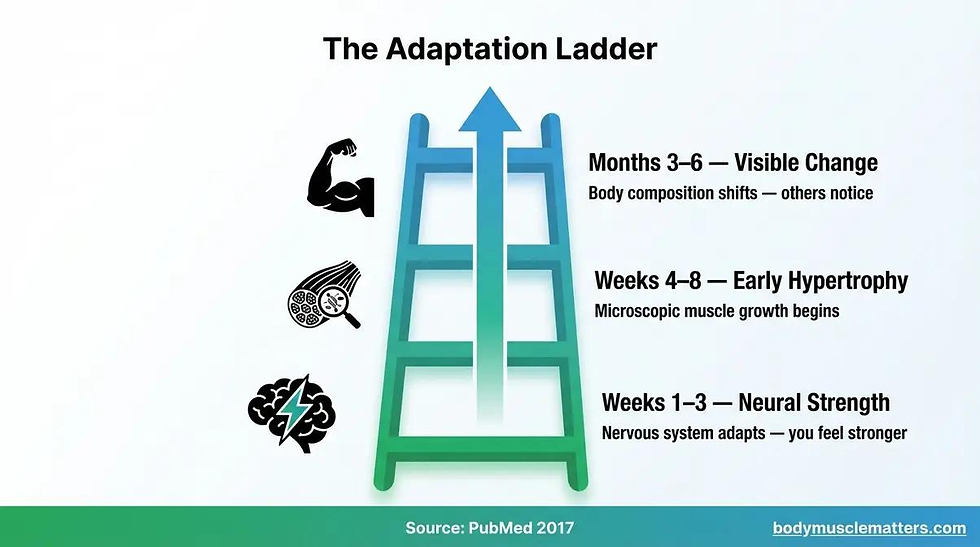
Small amounts of exercise-induced inflammation trigger muscle repair and adaptation, leading to greater strength and resilience.
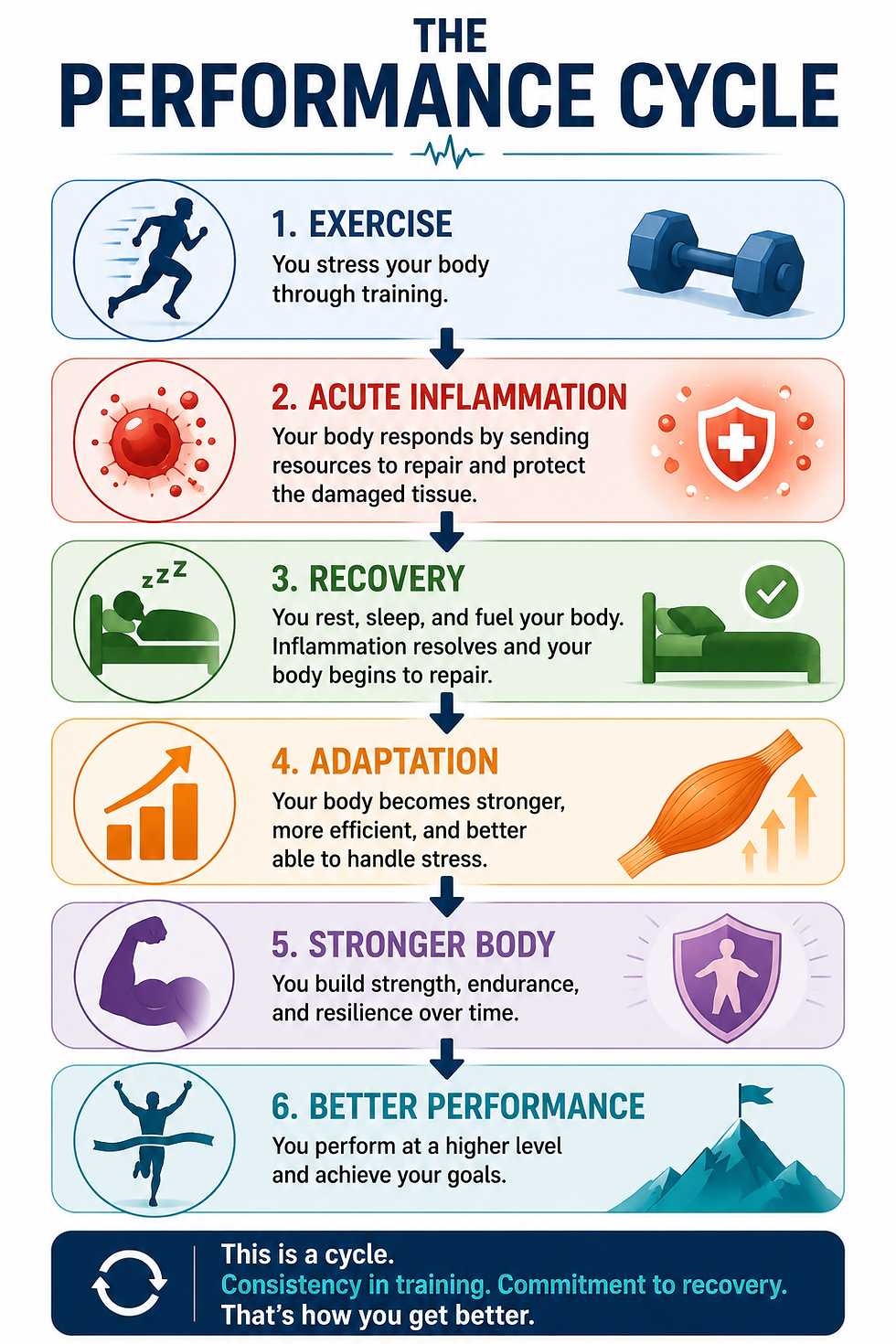
The Inflammation-Recovery Cycle
Training is only half of the equation.
Recovery completes the cycle.
Healthy adaptation looks like this:
Workout
↓
Acute inflammation
↓
Muscle repair
↓
Adaptation
↓
Improved performance
If recovery is interrupted...
The cycle stops.
Recovery Is Where Progress Happens
This is one of the biggest misconceptions in fitness.
People often think:
More training = Better results.
Reality:
More adaptation = Better results.
Adaptation only occurs if inflammation resolves.
That's why recovery is just as important as the workout itself.
🛌 Sleep: The Ultimate Anti-Inflammatory Tool
Sleep is where inflammation begins to resolve.
During deep sleep:
Growth hormone increases
Tissue repair accelerates
Muscle protein synthesis rises
Inflammatory chemicals decrease
Recovery hormones increase
Poor sleep keeps inflammatory pathways activated.
Instead of healing...
The body remains stressed.
This explains why athletes who sleep poorly often experience:
More soreness
Slower recovery
Increased injury risk
Reduced performance
HRV: Your Recovery Dashboard
Your Heart Rate Variability often reflects how well inflammation is resolving.
Healthy recovery usually looks like:
Exercise
↓
Temporary HRV drop
↓
Recovery
↓
HRV rebounds
↓
Body adapts
If HRV remains suppressed for several days...
Recovery may not be keeping pace with training.

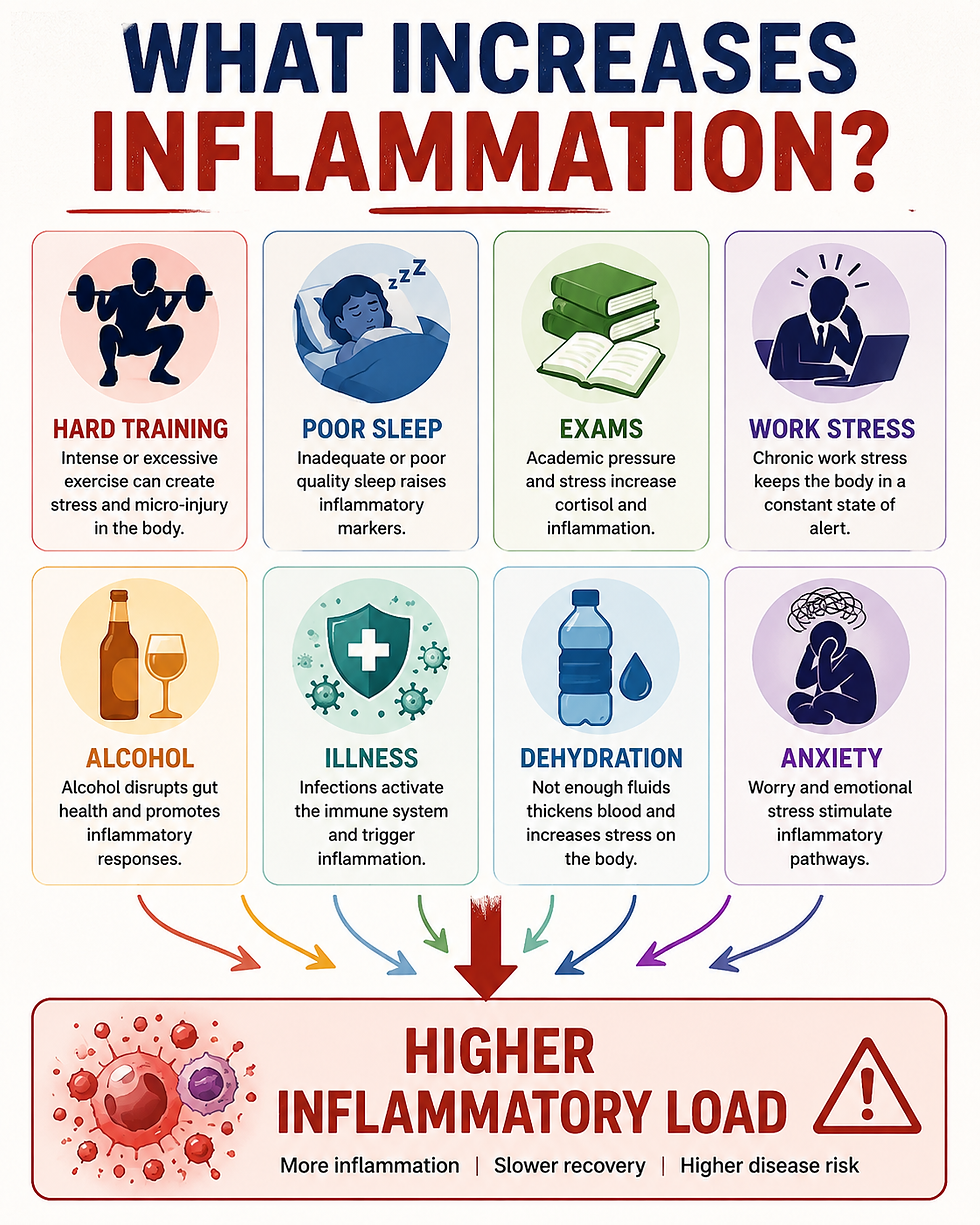
Stress Is Also Inflammation
Exercise isn't the only thing that creates inflammatory stress.
Your body also responds to:
Exams
Work deadlines
Poor sleep
Illness
Alcohol
Anxiety
Your immune system doesn't distinguish between physical stress and emotional stress.
Stress is stress.
When multiple stressors occur together...
Inflammation accumulates.
Overtraining: When Inflammation Never Turns Off
Temporary inflammation is healthy.
Persistent inflammation is not.
This is one reason overtraining develops.
The sequence often looks like:
Training
↓
Incomplete recovery
↓
More inflammation
↓
Poor sleep
↓
Higher cortisol
↓
Lower HRV
↓
Reduced performance
↓
More fatigue
↓
Even poorer recovery

Overtraining isn't caused by training alone—it occurs when recovery consistently fails to match the stress being applied.
The Peter Attia Perspective
Peter Attia often reminds us that exercise is one of the healthiest forms of stress.
Stress itself isn't harmful.
Failure to recover from stress is.
Inflammation follows the same principle.
Healthy inflammation leads to adaptation.
Chronic inflammation leads to dysfunction.
The Gabrielle Lyon Perspective
Gabrielle Lyon emphasizes that muscle serves as one of the body's most important organs for healthy aging.
Every resistance workout intentionally creates small amounts of inflammation.
That inflammation stimulates muscle remodeling.
Over time:
More muscle
↓
Better metabolism
↓
Better inflammatory regulation
↓
Healthier aging
Inflammation is therefore part of the solution—not simply the problem.
👤 How This Applies to You
🎓 High School
Training hard while sleeping five hours a night?
You're increasing inflammation faster than your body can recover.
🏫 College
Late nights, stress, poor nutrition, and inconsistent training often create chronic low-grade inflammation.
Recovery becomes your competitive advantage.
💼 Adults
You don't need marathon training to experience inflammation.
Work stress, poor sleep, obesity, and inactivity may quietly increase inflammatory burden for years.
BodyDashboard Insight
The goal isn't to avoid inflammation.
The goal is to recover from it.

Quick Recap
✅ Exercise creates healthy inflammation.
✅ Recovery turns inflammation into adaptation.
✅ Sleep is one of the body's strongest anti-inflammatory tools.
✅ HRV helps monitor recovery.
✅ Chronic stress increases inflammation.
✅ Overtraining occurs when recovery cannot keep pace.
Coming Up in Part 2B
We'll explore:
Anti-inflammatory nutrition
Foods that fight inflammation
Omega-3 fats
The Mediterranean diet
Gut health
Alcohol and inflammation
Supplements
The BodyDashboard Inflammation Score™
Continue Exploring BodyDashboard
👉 What Is VO₂ Max? Why It Matters for Your Energy, Performance, and Health
👉 Understanding Heart Rate Variability (HRV): The Ultimate Guide
👉 Why Sleep Is the Ultimate Performance Enhancer
👉 Nutrition: Fueling Performance, Recovery, and Longevity
👉 Resistance Training: The Hidden Key to Strong Bones and Lifelong Health
About BodyDashboard
Understand Your Body. Improve Your Performance. Extend Your Healthspan.
BodyDashboard is a science-based platform exploring how sleep, nutrition,
exercise, recovery, and physiology shape everything from daily performance to long-term health.
Built for student-athletes, fitness enthusiasts, and anyone curious about how the body actually works, BodyDashboard connects physiology research to practical, everyday decisions—helping readers improve energy, recovery, endurance, focus, resilience, and overall performance through simple, evidence-based systems.
Performance today. Health tomorrow. Longevity for life.


Comments