Understanding Heart Rate Variability (HRV): The Ultimate Guide to Recovery, Performance, and Longevity (Part 1)

What is Heart Rate Variability (HRV)? Learn how HRV measures recovery, stress, nervous system health, athletic performance, and longevity—and discover how to use it to optimize your training and everyday life.

Heart Rate Variability is one of the most powerful—and misunderstood—metrics available for understanding your body's readiness to perform.
Understand Your Body. Improve Your Performance.
Have you ever wondered why one day you feel unstoppable, yet the next day your workout feels unusually difficult—even though nothing changed?
Welcome to your BodyDashboard update.
Most people judge their readiness based on how they feel.
Elite athletes increasingly rely on something far more objective:
Heart Rate Variability (HRV).
HRV has become one of the most discussed health metrics in sports science and wearable technology. Devices like WHOOP, Oura Ring, Apple Watch, Garmin, Polar, and Hume all measure HRV because it offers a unique window into how well your body is adapting to stress.
But here's the surprising part:
A higher HRV isn't just about better athletic performance—it often reflects a healthier, more adaptable nervous system.
In many ways, HRV serves as your body's daily report card.
Let's read the dashboard.
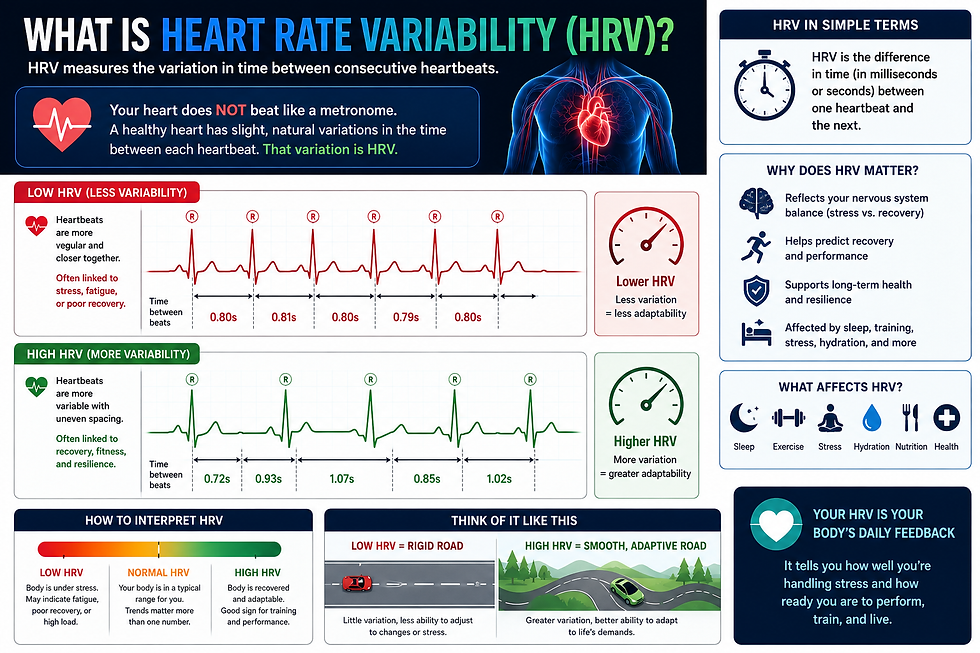
What Is Heart Rate Variability?
Many people assume that a healthy heart beats like a perfectly timed metronome:
60 beats per minute.
One beat every second.
But that's not actually what happens.
A healthy heart does not beat at perfectly regular intervals.
Instead, the time between each heartbeat changes slightly.
For example:
Beat 1 → 0.93 seconds
Beat 2 → 1.02 seconds
Beat 3 → 0.96 seconds
Beat 4 → 1.01 seconds
These tiny differences are called:
Heart Rate Variability (HRV)
In simple terms:
HRV measures the variation in time between consecutive heartbeats.
It isn't measuring how fast your heart beats.
It's measuring how adaptable your heart is.
HEART RATE vs HEART RATE VARIABILITY
Why Isn't a Perfectly Regular Heartbeat Better?
This is where HRV becomes fascinating.
Your heart is constantly responding to information from your brain.
Every second, your nervous system adjusts your heartbeat depending on:
Stress
Recovery
Exercise
Sleep
Illness
Hydration
Mental state
A healthy nervous system is constantly making these tiny adjustments.
Think of it like suspension on a sports car.
A rigid suspension doesn't adapt.
A responsive suspension constantly adjusts to the road.
Your nervous system works the same way.
Higher variability usually means your body can adapt more efficiently.
Meet Your Autonomic Nervous System
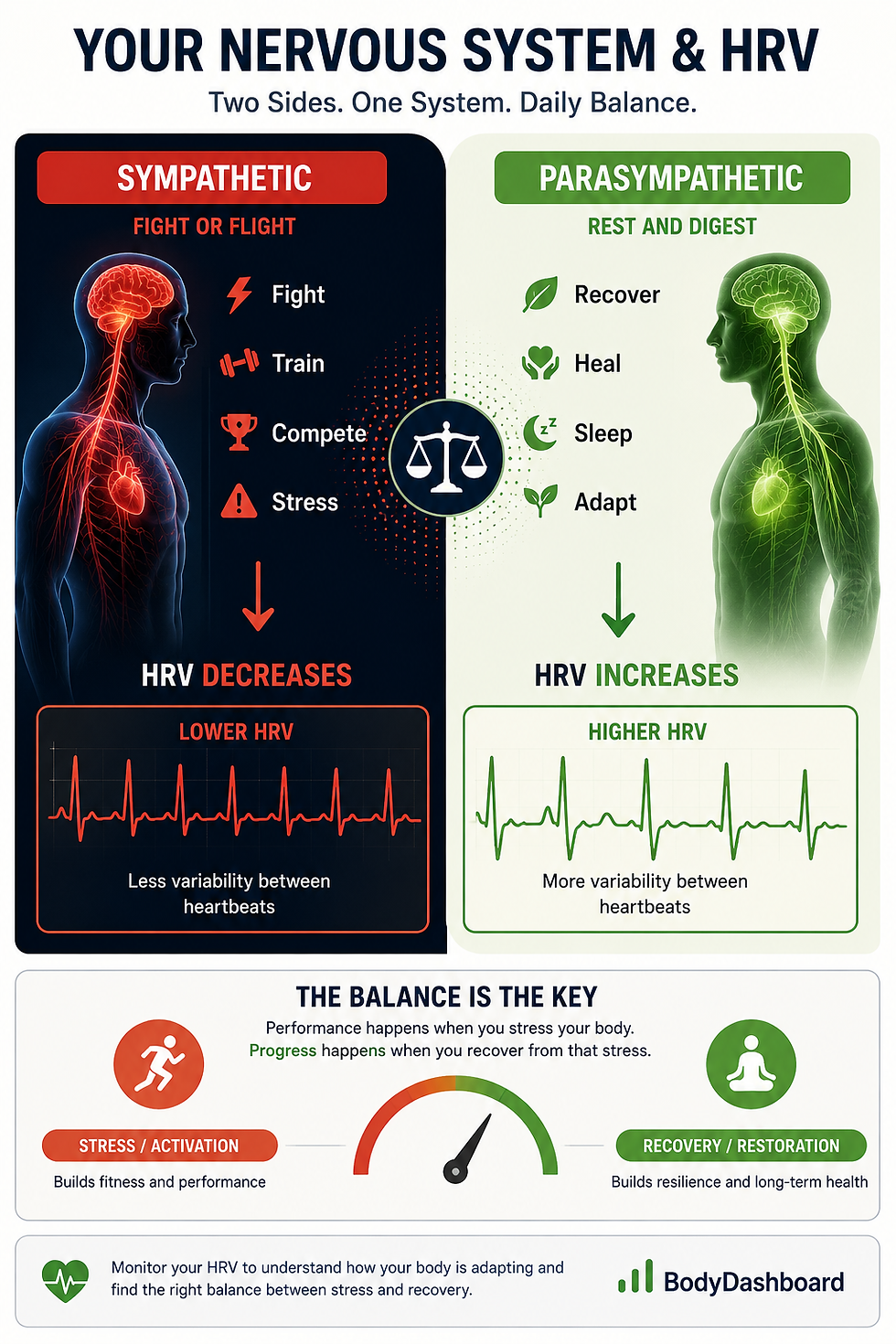
Your HRV is largely controlled by the autonomic nervous system.
It has two major branches.
⚡ Sympathetic Nervous System
Often called:
Fight or Flight
Its job is to prepare you for action.
When activated:
Heart rate increases
Blood pressure rises
Stress hormones increase
Muscles prepare for work
Useful for:
Competition
Heavy lifting
Exams
Emergencies
🌿 Parasympathetic Nervous System
Often called:
Rest and Digest
Its job is recovery.
When activated:
Heart rate slows
Digestion improves
Recovery accelerates
Growth and repair occur
Useful for:
Sleeping
Recovering
Healing
Relaxing
Why Athletes Care About HRV
Years ago, athletes judged recovery by asking:
"Do I feel sore?"
Today, many ask a different question:
"What is my HRV?"
That's because HRV often changes before you notice symptoms.
A declining HRV may indicate:
Poor sleep
High stress
Illness
Excessive training
Inadequate recovery
Conversely, a higher HRV often reflects:
Good recovery
Balanced training
Healthy sleep
Lower physiological stress
Rather than waiting until performance declines, HRV allows athletes to recognize when recovery may need more attention.

HRV Is More Than an Athletic Metric
One of the reasons HRV has attracted so much attention is that it extends beyond sports.
Research suggests HRV reflects overall autonomic nervous system function.
It has been studied in relation to:
Cardiovascular health
Mental health
Stress resilience
Recovery
Aging
This fits remarkably well with Peter Attia's philosophy in Outlive.
Rather than waiting for disease to develop, Attia encourages measuring physiological markers that help us understand health before problems appear.
HRV isn't a diagnosis.
But it can be viewed as an indicator of how well your body is adapting to daily stress.
BodyDashboard Insight
HRV isn't measuring your heart.
It's measuring how well your body is responding to life.
How This Applies to You
🎓 High School
Late-night studying.
Sports.
Social media.
Early school.
These all influence recovery—even if you don't notice it immediately.
HRV can help reveal whether your body is adapting or accumulating stress.
🏫 College
Classes.
Workouts.
Exams.
Travel.
Inconsistent sleep.
HRV provides a snapshot of whether your body is keeping up with these demands.
💼 Adults
Work stress.
Family responsibilities.
Exercise.
Poor sleep.
HRV helps determine whether your recovery matches your workload.
Quick Recap
✅ HRV measures the variation between heartbeats.
✅ Higher HRV generally reflects greater adaptability.
✅ HRV is controlled by your autonomic nervous system.
✅ It responds to sleep, stress, illness, exercise, and recovery.
✅ HRV is becoming one of the most valuable metrics in sports science and preventive health.
Coming Up in Part 2
In the next installment, we'll explore:
Why sleep has the greatest influence on HRV
HRV and overtraining syndrome
How VO₂ max affects HRV
Nutrition and hydration
Stress and cortisol
How elite athletes use HRV to adjust training
Why your HRV may suddenly drop
We'll also begin building your personal BodyDashboard Recovery System.
Related BodyDashboard Articles
What Is VO₂ Max? Why It Matters for Your Energy, Performance, and Health
Why Sleep Is the Ultimate Performance Enhancer
Nutrition: Fueling Performance, Recovery, and Longevity
Resistance Training: The Hidden Key to Strong Bones and Lifelong Health
How to Recover Faster After Workouts (Coming Soon)
References
Harvard Medical School. Heart Rate Variability: A New Way to Track Well-Being.
Cleveland Clinic. Heart Rate Variability (HRV).
Whoop. Heart Rate Variability (HRV): What It Is and Why It Matters.
Outlive.
Forever Strong.
About BodyDashboard
Understand Your Body. Improve Your Performance. Extend Your Healthspan.
BodyDashboard is a science-based platform exploring how sleep, nutrition, exercise, recovery, and physiology shape everything from daily performance to long-term health.
Built for student-athletes, fitness enthusiasts, and anyone curious about how the body actually works, BodyDashboard connects physiology research to practical, everyday decisions—helping readers improve energy, recovery, endurance, focus, resilience, and overall performance through simple, evidence-based systems.
Performance today. Health tomorrow. Longevity for life.
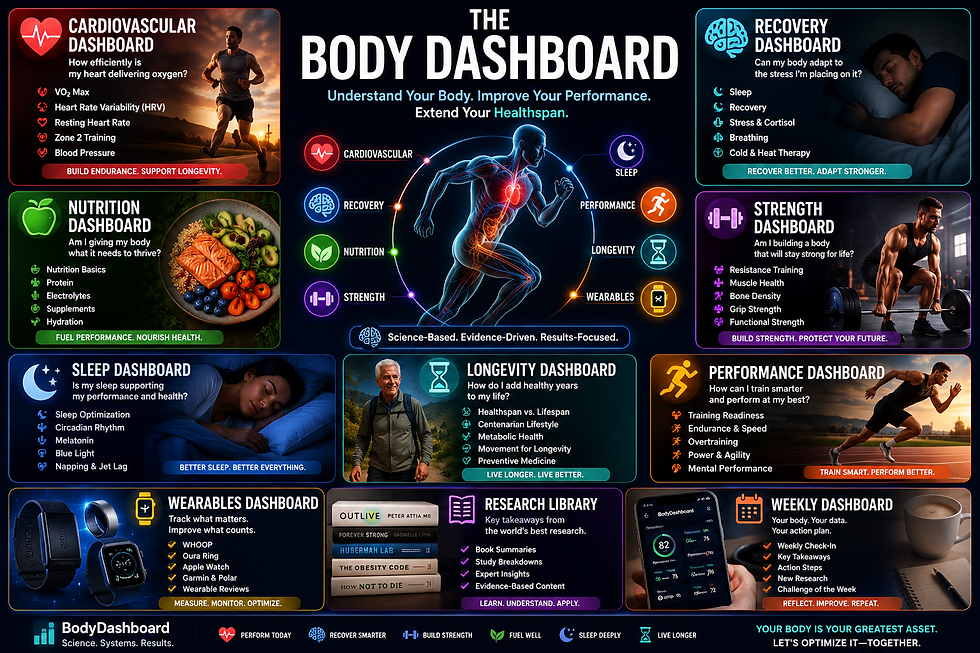
Continue Exploring BodyDashboard
If you enjoyed learning about Heart Rate Variability, these science-based guides will help you better understand how your body performs, recovers, and adapts.
❤️ Recovery & Performance
➜ What Is VO₂ Max? Why It Matters for Your Energy, Performance, and
Health
Discover why VO₂ max is considered the gold standard of cardiovascular fitness and one of the strongest predictors of long-term health. Learn how improving aerobic capacity can increase endurance, boost recovery, and even extend healthspan.
Suggested URL:/vo2-max-guide
➜ Why Sleep Is the Ultimate Performance Enhancer
Sleep isn't passive recovery—it's when your body repairs muscles, regulates hormones, consolidates memories, and prepares for peak performance. Learn why improving sleep may be the single biggest performance upgrade available.
Suggested URL:/sleep-performance
➜ How to Recover Faster After Workouts (Coming Soon)
Recovery isn't just about resting—it's about adapting. Learn the science behind muscle repair, inflammation, hydration, nervous system recovery, and practical strategies to bounce back stronger after every workout.
Suggested URL:/recover-faster-after-workouts
🍎 Nutrition & Metabolism
➜ Nutrition: Fueling Performance, Recovery, and Longevity
Discover how nutrition influences energy production, muscle growth, recovery, metabolic health, and healthy aging. Learn why food isn't simply fuel—it's information that shapes every system in your body.
Suggested URL:/nutrition-performance-longevity
➜ Are Electrolytes Actually Worth It? (Coming Soon)
Do electrolyte drinks really improve hydration and performance? Learn when you actually need them, how they work, and how to avoid wasting money on products that don't match your training.
Suggested URL:/electrolytes-guide
🏋️ Strength & Longevity
➜ Resistance Training: The Hidden Key to Strong Bones and Lifelong Health
Learn how lifting weights strengthens your skeleton, increases bone density, reduces fracture risk, and supports healthy aging. Discover why resistance training is one of the best investments you can make in your future health.
Suggested URL:/resistance-training-bone-density
➜ Why Muscle Is the Organ of Longevity (Coming Soon)
Inspired by Dr. Gabrielle Lyon's Forever Strong, discover why preserving muscle mass is essential not only for athletic performance but also for metabolic health, mobility, and independence throughout life.
Suggested URL:/muscle-organ-of-longevity
🧠 Healthspan & Recovery Science
➜ Understanding Heart Rate Variability (HRV): The Ultimate Guide to Recovery, Performance, and Longevity
Learn how HRV reflects your body's ability to adapt to stress, recover from exercise, and optimize training. Discover why elite athletes and wearable devices rely on HRV to guide performance.
Suggested URL:/heart-rate-variability-guide
➜ Healthspan vs. Lifespan: Why Living Better Matters More Than Living Longer (Coming Soon)
Peter Attia popularized the idea that adding healthy years to life is just as important as adding years to life. Learn what healthspan means and how exercise, nutrition, sleep, and recovery all contribute to it.
Suggested URL:/healthspan-vs-lifespan
The BodyDashboard
Understand Your Body. Improve Your Performance. Extend Your Healthspan.
A science-based operating manual for the human body.


Comments