Understand Your Body. Improve Your Performance.

Updated: Aug 31
You crushed leg day yesterday.
Today...
Walking downstairs feels impossible.
Sitting down hurts.
Standing up hurts.
Even laughing somehow hurts.
Congratulations.
You've probably experienced Delayed Onset Muscle Soreness, better known as DOMS.
Most people assume soreness means:
"I had an amazing workout."
Others think:
"Lactic acid is trapped in my muscles."
Neither is entirely true.
At BodyDashboard, we believe muscle soreness is a valuable signal—but only when you understand what it's actually telling you.
Let's read the dashboard.
What Is DOMS?
DOMS stands for:
Delayed Onset Muscle Soreness
Unlike the burning sensation you feel during exercise...
DOMS develops later.
Most people notice:
Mild soreness 8–12 hours later
Increasing soreness after 24 hours
Peak soreness between 24–72 hours
Gradual improvement over several days
This delay is what makes DOMS unique.
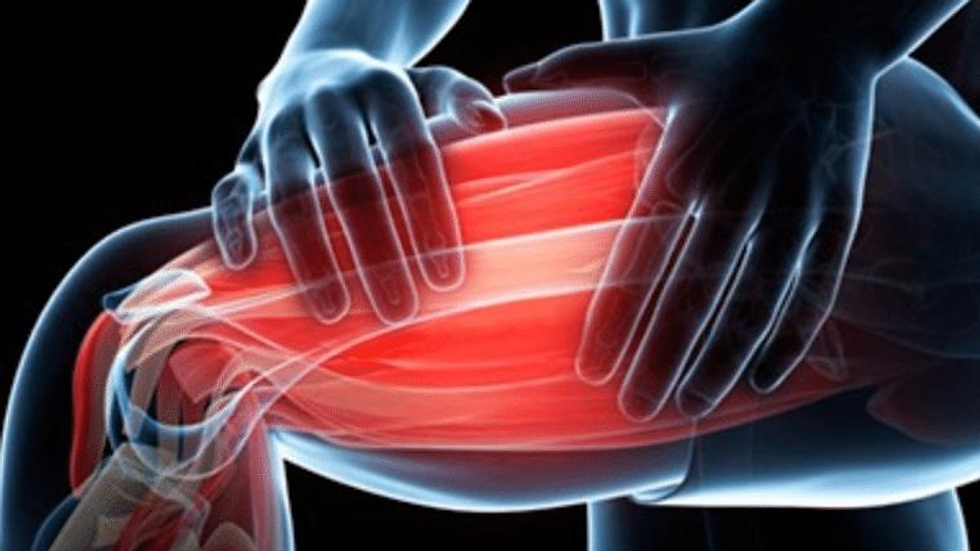
DOMS develops gradually because your body is responding to microscopic muscle damage and beginning the repair process.
What Actually Causes DOMS?
For decades, people blamed:
❌ Lactic acid.
Today we know that's incorrect.
Lactic acid clears from muscles within about an hour after exercise.
DOMS begins long after lactate is gone.
Instead, DOMS is primarily caused by:
Microscopic muscle fiber damage
Connective tissue stress
Temporary inflammation
Fluid shifts within muscle tissue
This is particularly common after exercises emphasizing the eccentric (lengthening) phase of movement.
Examples include:
Walking downhill
Lowering a squat
Lowering a dumbbell
Nordic hamstring curls
These movements place high mechanical stress on muscle fibers.
BodyDashboard Insight
DOMS isn't caused by lactic acid.
It's caused by your muscles adapting to a challenge they're not yet accustomed to.
The Timeline of DOMS
🕒 What Happens After a Workout?
Immediately After Exercise
You may feel tired.
You may feel a temporary burn.
That's not DOMS.
8–12 Hours
Muscles begin feeling stiff.
24–48 Hours
Soreness typically increases.
Inflammatory cells continue repairing tissue.
48–72 Hours
Peak soreness.
This is when stairs become your enemy.
3–7 Days
Recovery continues.
Muscles become more resilient.

Why Does Exercise Damage Muscle?
That sounds alarming.
But it's actually a normal part of training.
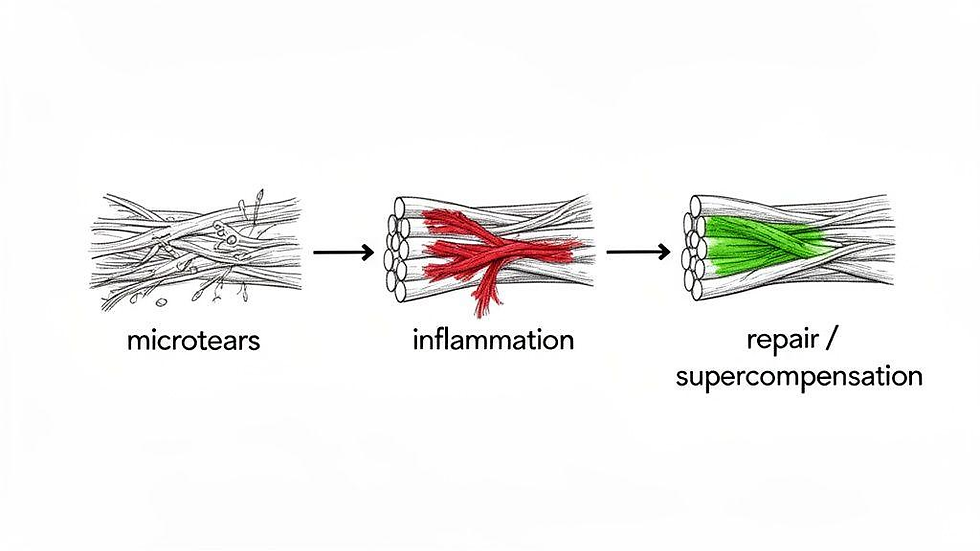
Exercise creates microtrauma.
Tiny disruptions occur within muscle fibers.
Your immune system responds.
Inflammation begins.
Satellite cells activate.
Muscle proteins are rebuilt.
The end result:
A stronger muscle than before.
This process is called:
Adaptation
Does Soreness Mean Muscle Growth?
This is one of the biggest myths in fitness.
The answer is:
Not necessarily.
Soreness can occur because:
You performed a new exercise
You increased training volume
You emphasized eccentric contractions
But muscle growth can occur with:
Little soreness
Moderate soreness
Significant soreness
In fact...
Many elite athletes experience very little soreness despite making tremendous progress.
Why?
Their bodies have adapted.
BodyDashboard Insight
Muscle growth comes from progressive overload—not from chasing soreness.
Why Beginners Get More Sore
Think back to your first week in the gym.
Everything hurt.
Weeks later...
The exact same workout barely caused soreness.
That's because your body learned.
Scientists call this:
The Repeated Bout Effect
After repeated exposure to the same exercise:
Muscle damage decreases
Inflammation decreases
DOMS decreases
Recovery improves
This is one of the body's most remarkable adaptations.
The Inflammation Connection
DOMS and inflammation are closely related.
After muscle damage:
Immune cells enter the muscle.
↓
Inflammation increases.
↓
Damaged tissue is removed.
↓
Repair begins.
↓
Adaptation occurs.
This is why our previous article—
Inflammation: Friend or Foe
—is directly connected to DOMS.
Healthy inflammation supports recovery.
Chronic inflammation interferes with it.
The Peter Attia Perspective
Peter Attia frequently emphasizes that exercise is a beneficial stressor.
Temporary muscle damage isn't something to fear.
It's the signal that tells your body to improve.
What matters is allowing sufficient recovery for adaptation to occur.
The Gabrielle Lyon Perspective
Gabrielle Lyon often reminds us that muscle is one of the body's most important organs.
Healthy muscle isn't built by avoiding challenge.
It's built by:
Challenge
↓
Recovery
↓
Adaptation
Repeated consistently over time.
DOMS is sometimes part of that journey—but it isn't the destination.
👤 How This Applies to You
🎓 High School
Feeling sore after trying a new sport?
That's normal.
Keep moving.
Recover well.
Your body is learning.
🏫 College
More soreness doesn't mean more progress.
Consistency beats punishment.
💼 Adults
Don't let soreness discourage you.
As your body adapts, soreness usually decreases—even while fitness continues improving.

BodyDashboard Insight
Don't measure your workout by how sore you feel tomorrow.
Measure it by how much stronger you become next month.
Quick Recap
✅ DOMS usually peaks 24–72 hours after exercise.
✅ DOMS is not caused by lactic acid.
✅ Muscle damage triggers inflammation and repair.
✅ Eccentric exercise often causes the greatest soreness.
✅ Soreness is not required for muscle growth.
✅ Adaptation—not soreness—is the goal.
Coming Up in Part 2A
We'll explore:
How to recover faster from DOMS
Sleep and muscle soreness
HRV and recovery
Active recovery vs complete rest
Nutrition for muscle repair
Should you train when you're sore?
The difference between DOMS and injury
Continue Exploring BodyDashboard
👉 Inflammation: Friend or Foe
👉 Understanding Heart Rate Variability (HRV): The Ultimate Guide
👉 Why Sleep Is the Ultimate Performance Enhancer
👉 Nutrition: Fueling Performance, Recovery, and Longevity
👉 Resistance Training: The Hidden Key to Strong Bones and Lifelong Health
👉 How Stress Impacts Your Gains
References
Cleveland Clinic. Delayed Onset Muscle Soreness (DOMS).
Runner's World. What Causes DOMS?
Men's Health. Is DOMS a Sign of Muscle Growth?
UVA Health. Avoiding Post-Workout Soreness and Rhabdomyolysis.
Women's Health. Does DOMS Mean Muscle Growth?
Outlive.
Forever Strong.
About BodyDashboard
Understand Your Body. Improve Your Performance. Extend Your Healthspan.
BodyDashboard is a science-based platform exploring how sleep, nutrition, exercise, recovery, and physiology shape everything from daily performance to long-term health.
Built for student-athletes, fitness enthusiasts, and anyone curious about how the body actually works, BodyDashboard connects physiology research to practical, everyday decisions—helping readers improve energy, recovery, endurance, focus, resilience, and overall performance through simple, evidence-based systems.
Performance today. Health tomorrow. Longevity for life.
---wix---


Comments